Banana Farming in India: Complete Cultivation Guide for High Yield
Banana isn’t just India’s favorite fruit – it’s a powerhouse of opportunity for farmers across the country. From the southern plains of Tamil Nadu to the eastern fields of West Bengal, banana cultivation has transformed countless farming families’ livelihoods. With India being the world’s largest producer of bananas, contributing over 25% of global production, the scope for profitable banana farming has never been better.
What makes banana farming particularly attractive is its quick return on investment. Unlike many fruit crops that take years to bear, banana plants can give you a harvest in just 9-12 months. Whether you’re a small farmer with a few acres or planning large-scale commercial cultivation, bananas offer flexibility, consistent demand, and multiple income streams through value addition.
This comprehensive guide covers everything from selecting the right variety to post-harvest management. We’ll focus on practical, field-tested methods that work in Indian conditions, helping you avoid common mistakes and maximize your profits from banana cultivation.
Table of Contents
- Quick Banana Crop Overview
- About Banana Fruit
- Climate & Soil Requirements
- Popular Banana Varieties
- Propagation Methods
- Land Preparation
- Planting Method
- Irrigation Management
- Fertilizer Schedule
- Intercropping & Weed Management
- Pruning & Training
- Pest & Disease Management
- Flowering & Fruiting
- Harvesting Techniques
- Yield Potential
- Storage & Marketing
- Cost & Profitability Analysis
- Advantages of Banana Farming
- Government Support Schemes
- Organic Banana Farming
- Common Mistakes to Avoid
- Frequently Asked Questions
- Conclusion
🌱 Banana Crop Overview at a Glance
| Parameter | Details |
|---|---|
| Scientific Name | Musa spp. |
| Botanical Family | Musaceae |
| Origin | Southeast Asia |
| Climate Requirement | Tropical & Subtropical |
| Soil Type & pH | Deep, well-drained loam; pH 6.0-7.5 |
| Planting Season | June-July (Kharif), Feb-March (Spring) |
| Spacing | 1.8m x 1.8m (1500 plants/acre) |
| Harvesting Time | 9-12 months after planting |
| Yield Per Acre | 25-40 tonnes (G9 variety) |
| Economic Lifespan | 1 main crop + 2-3 ratoon crops |
About Banana Fruit
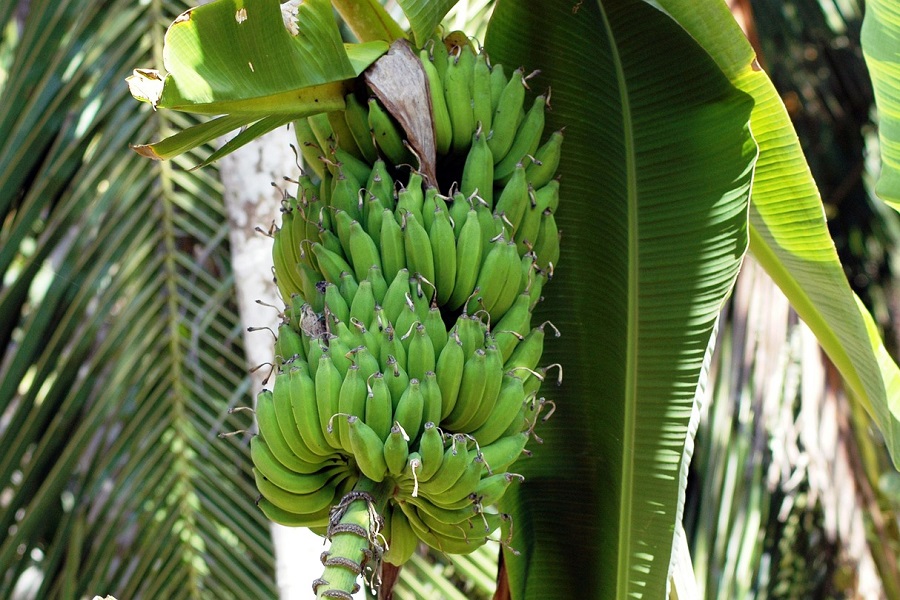
Banana, scientifically known as Musa spp., is technically a berry and one of the world’s most important fruit crops. Though often called a tree, the banana plant is actually a giant herb with a pseudostem made of tightly packed leaf sheaths. India has been cultivating bananas for thousands of years, with references found in ancient texts and historical records.
Nutritionally, bananas are a powerhouse. They are rich in potassium, vitamin B6, vitamin C, dietary fiber, and natural sugars. They provide instant energy and are beneficial for heart health, digestion, and blood pressure regulation. Both ripe and raw bananas have significant culinary importance in Indian cuisine.
Economic Importance: Banana is a crucial cash crop for Indian farmers. It provides year-round income and supports numerous agro-industries. The fruit has multiple uses beyond fresh consumption, making it economically versatile.
Commercial & Processing Uses:
- Fresh Consumption: Table varieties like Grand Naine (G9), Robusta, and Poovan
- Processing: Chips, banana puree, banana flour, and banana powder
- Value-Added Products: Banana wine, vinegar, jam, and baby food
- Industrial Uses: Banana fiber for textiles, paper, and handicrafts
- Export: Fresh bananas to Middle East, Europe, and neighboring countries
Climate & Soil Requirements for Banana
🌤️ Ideal Climate for Banana Cultivation
- Suitable Climate: Warm, humid tropical climate with temperature range of 15°C to 35°C
- Temperature Range: Optimal growth at 25°C to 30°C. Growth stops below 15°C
- Rainfall Requirement: 1500-2500 mm annually, well distributed
- Frost Sensitivity: Highly sensitive – frost can kill plants
- Sunlight Needs: Requires plenty of sunlight, at least 6-8 hours daily
- Wind Protection: Needs protection from strong winds which can damage plants
🌱 Best Soil for Banana Farming
- Best Soil Type: Deep, well-drained loamy soil rich in organic matter
- Soil pH Range: 6.0 to 7.5 (slightly acidic to neutral)
- Drainage Requirement: Excellent drainage is crucial – waterlogging kills plants
- Soil Preparation Tip: Conduct soil testing for pH and nutrient status before planting
📍 India Context: Best States and Regions
- Major Banana Producing States: Tamil Nadu, Maharashtra, Gujarat, Karnataka, Andhra Pradesh, Telangana, Bihar, West Bengal
- High Productivity Regions: Jalgaon (Maharashtra), Trichy (Tamil Nadu), Anand (Gujarat)
- Practical Advice: Choose varieties suited to your region’s climate and market demand
Best Banana Varieties for Cultivation in India
1. Commercial Varieties (Most Popular)
- Grand Naine (G9): Most popular for export, high yield (40-50 kg/bunch), good shelf life
- Robusta: Widely grown in South India, good taste, medium-sized bunches
- Dwarf Cavendish: Suitable for windy areas, resistant to lodging
- Poovan: Popular in Tamil Nadu, resistant to leaf spot disease
- Nendran: Used for chips in Kerala, excellent for processing
- Red Banana: High medicinal value, commands premium price
2. Region-wise Suitability
| Region | Recommended Varieties |
|---|---|
| North India | G9, Dwarf Cavendish, Basrai |
| South India | Robusta, Nendran, Poovan, G9 |
| West India | G9, Shrimanti, Lal Velchi |
| East India | Chini Champa, Martaman, G9 |
Tip: For commercial farming, Grand Naine (G9) is highly recommended due to its high yield, export potential, and market preference.
Propagation Methods in Banana
Banana is commercially propagated through vegetative methods. Tissue culture plants are recommended for commercial cultivation.
1. Tissue Culture Plants (Recommended)
- Advantages: Disease-free, uniform growth, early fruiting, higher yield
- Planting Material: Buy from certified tissue culture labs like Jain Irrigation, AVT, etc.
- Cost: ₹15-25 per plant depending on variety and season
2. Sucker Propagation (Traditional)
- Types of Suckers: Sword suckers (preferred) and water suckers
- Preparation: Select healthy suckers, trim roots, treat with fungicide
- Limitations: Risk of disease transmission, uneven growth
3. Plant Requirement per Acre
- High-Density Planting: 1.8m x 1.8m = 1500 plants/acre
- Moderate Density: 2m x 2m = 1089 plants/acre
- Wider Spacing: 2.5m x 2.5m = 696 plants/acre
- Practical Tip: Keep 10% extra plants for gap filling
Land Preparation for Banana Orchard
Proper land preparation is crucial for banana’s shallow root system and high nutrient requirements.
- Field Clearing: Remove all weeds, stones, and previous crop residues
- Deep Ploughing: 2-3 deep ploughings with disc harrow to loosen soil
- Leveling: Level the field perfectly for uniform irrigation
- Pit Digging:
- Dig pits of size 45cm x 45cm x 45cm
- Spacing: 1.8m x 1.8m for high-density planting
- Keep top soil and sub-soil separately
- Pit Filling & Treatment:
- Mix top soil with 10kg well-decomposed FYM
- Add 250gm Neem cake + 100gm SSP per pit
- For nematode control, add Carbofuran 3G @ 10gm/pit
- Fill pits 2-3 weeks before planting
- Drip System Installation: Install drip irrigation system before planting
Planting Method of Banana
Best Planting Seasons
- Kharif Season: June-July (for most parts of India)
- Spring Season: February-March (with irrigation facility)
- Rainfed Areas: Plant with onset of monsoon
Planting Technique
- Make small hole in center of prepared pit
- Place tissue culture plant carefully without damaging roots
- Planting depth: Same as in nursery bag/polybag
- Firm the soil around plant gently
- Water immediately after planting
Post-Planting Care
- Mulching: Apply organic mulch around plants to conserve moisture
- Shade: Provide temporary shade in summer planting
- Gap Filling: Replace dead plants within 15-20 days
- Support: Provide bamboo support for tall varieties
Irrigation Management in Banana Farming
Banana is a water-loving crop but sensitive to waterlogging. Proper irrigation is critical for good yield.
Water Requirements
- Total Water Requirement: 1800-2200 mm per crop cycle
- Summer: Irrigate every 3-4 days
- Winter: Irrigate every 7-8 days
- Rainy Season: No irrigation needed, ensure drainage
Critical Growth Stages for Irrigation
- Establishment Phase (1-3 months): Frequent light irrigation
- Vegetative Phase (4-7 months): Regular irrigation for leaf growth
- Flowering & Bunch Development (8-9 months): Adequate moisture crucial
- Fruit Filling Stage: Maintain soil moisture for fruit size
Drip Irrigation System (Highly Recommended)
- Benefits: 40-50% water saving, 25-30% yield increase
- System Design: 2 drippers per plant @ 4 LPH each
- Fertigation: Apply 70% fertilizers through drip system
- Government Subsidy: 50-60% subsidy available under PMKSY
Warning: Never allow waterlogging. Banana roots rot quickly in stagnant water.
Manure & Fertilizer Schedule for Banana
Banana is a heavy feeder requiring balanced nutrition for optimal yield.
| Time After Planting | Fertilizer Application (per plant) | Method |
|---|---|---|
| At Planting | 10kg FYM + 250gm Neem cake + 100gm SSP | Mix in pit |
| 30 Days | 50gm Urea + 50gm MOP | Apply in circular trench 30cm from plant. Mix in soil and irrigate. For drip fertigation, split monthly dose into weekly applications. |
| 60 Days | 100gm Urea + 100gm MOP | |
| 90 Days | 150gm Urea + 150gm MOP + 100gm SSP | |
| 120 Days | 150gm Urea + 150gm MOP | |
| 150 Days | 100gm Urea + 100gm MOP | |
| 180 Days | 50gm Urea + 50gm MOP | |
| Total/Plant | 600gm Urea + 600gm MOP + 200gm SSP | For one crop cycle |
Micronutrient Requirements
- Zinc: Foliar spray of 0.5% Zinc Sulphate at 3rd and 5th month
- Iron: 0.5% Ferrous Sulphate spray if yellowing appears
- Boron: 0.1% Borax spray at flowering stage
- Calcium: Important for fruit quality, apply Calcium Nitrate
Organic Alternatives
- Replace FYM with Vermicompost @ 5kg/plant
- Use Jeevamrut or Panchagavya for liquid nutrition
- Apply biofertilizers: Azospirillum + PSB @ 50gm/plant
Intercropping & Weed Management
🌾 Intercropping in Banana Orchard
During first 4-5 months, intercrops can provide additional income:
- Legumes: Cowpea, Moong, Soybean (fix nitrogen)
- Vegetables: Cabbage, Cauliflower, Onion, Garlic
- Spices: Turmeric, Ginger, Coriander
- Avoid: Tall crops that shade banana plants
Rule: Maintain 60cm clean circle around each banana plant
🌿 Weed Management
- Manual Weeding: First 4 months critical, weed every month
- Mulching: Apply 10-15cm thick organic mulch around plants
- Chemical Control: Pre-emergence herbicide like Glyphosate before weed emergence
- Intercropping: Smother crops reduce weed growth
Pruning and Training in Banana
Essential Pruning Operations
- Desuckering: Remove unwanted suckers regularly
- Keep only one follower sucker per plant
- Remove others when 30-45cm tall
- Use sharp knife, cut close to mother plant
- Leaf Pruning:
- Remove diseased, dried, and old leaves
- Maintain 8-10 healthy leaves at flowering
- Improves air circulation and reduces disease
- Flower Pruning: Remove male bud after last hand has set
- Deflowering: Remove female flowers from last 1-2 hands for better bunch size
Training Practices
- Propping: Support plants with bamboo poles during bunch development
- Bunch Covering: Use perforated blue polyethylene covers
- Protects from sun, pests, and cold
- Improves fruit color and quality
- Increases temperature for early maturity
Pests and Diseases in Banana Farming
Major Pests
| Pest | Symptoms | Control Measures |
|---|---|---|
| Banana Aphid | Curled leaves, transmits bunchy top virus | Imidacloprid 0.005% spray, remove infected plants |
| Pseudostem Borer | Holes in stem, oozing sap | Carbofuran 3G @ 10gm/plant, pheromone traps |
| Fruit Scarring Beetle | Scars on fruit skin | Bag bunches, Carbaryl 0.1% spray |
| Nematodes | Stunted growth, root galls | Carbofuran, Neem cake, crop rotation |
| Thrips | Brown streaks on fruit | Bagging, Dimethoate 0.05% spray |
Major Diseases
| Disease | Symptoms | Control Measures |
|---|---|---|
| Panama Wilt (Fusarium) | Yellowing of leaves, splitting pseudostem | Use resistant varieties, soil solarization |
| Sigatoka Leaf Spot | Brown spots on leaves, early drying | Mancozeb 0.2% spray, remove infected leaves |
| Bunchy Top Virus | Stunted growth, dark green streaks | Remove infected plants, control aphids |
| Anthracnose | Black spots on fruits | Carbendazim 0.1% spray, proper sanitation |
| Bacterial Wilt | Yellow ooze from cut stem | Use disease-free planting material |
Preventive Measures
- Use tissue culture plants from certified labs
- Practice crop rotation with paddy or sugarcane
- Maintain field sanitation
- Regular monitoring and early intervention
Flowering and Fruiting in Banana
Flowering Phase
- Flowering Time: 6-8 months after planting
- Flower Structure: Inflorescence emerges from center
- Flower Types: Female flowers (first) → Neutral flowers → Male flowers
- Pollination: Mostly parthenocarpic (no pollination needed)
Fruit Development
- Bunch Formation: 8-12 hands per bunch typical
- Fruit Filling: 90-120 days from flowering to harvest
- Growth Regulators: Use planofix (NAA) for uniform fruit size
- Critical Stage: 30-60 days after flowering for maximum fruit growth
Factors Affecting Fruit Quality
- Adequate potassium for sweetness
- Proper irrigation for fruit size
- Temperature: 25-30°C ideal for fruit development
- Bunch covering for color and quality
Harvesting of Banana
Harvest Timing
- Maturity Indicators:
- Fruits become plump and angular
- Light green color with dull appearance
- 85-90% maturity for distant markets
- 90-95% maturity for local markets
- Harvesting Age: 9-12 months after planting depending on variety
- Best Time: Morning hours to reduce field heat
Harvesting Method
- Cut pseudostem about 30cm above the bunch
- Lower bunch gently using two people
- Place on padded surface or banana leaves
- Remove bracts and style remnants
- Carry bunch on padded shoulder or trolley
Post-Harvest Handling
- Dehanding: Cut into hands for marketing
- Washing: Clean with chlorinated water to remove latex
- Grading: Sort by size, color, and quality
- Packaging: Use CFB boxes with polyethylene lining
- Ripening: Use ethylene gas (100-150 ppm) in ripening chambers
Yield of Banana Crop
Expected Yield
| Parameter | Grand Naine (G9) | Traditional Varieties |
|---|---|---|
| Yield per Plant | 25-35 kg | 15-25 kg |
| Yield per Acre (1500 plants) | 35-45 tonnes | 20-30 tonnes |
| Yield per Hectare | 85-110 tonnes | 50-75 tonnes |
| Bunch Weight | 20-30 kg | 10-20 kg |
Factors Affecting Yield
- Planting Material: Tissue culture plants yield 20-30% more
- Spacing: Optimal spacing for light interception
- Nutrition: Balanced fertilization, especially potassium
- Water Management: Timely irrigation critical
- Pest Control: Effective disease management
Ratoon Cropping
- Main crop followed by 2-3 ratoon crops
- Ratoon crops mature 2-3 months earlier
- Reduce fertilizer by 20% for ratoon crops
- Maintain same management practices
Storage and Marketing of Banana
Storage Methods
- Green Banana Storage: 13-14°C at 85-95% RH for 2-3 weeks
- Ripe Banana Storage: 12-13°C for 5-7 days
- Cold Storage: For longer storage and price regulation
- Controlled Atmosphere: 5% O2 + 5% CO2 extends shelf life
Marketing Channels
- Local Markets: Direct to wholesalers or retailers
- Commission Agents: Through APMC markets
- Direct Sale: To processing units, hotels, institutions
- Export: To Middle East, Europe, Russia
- FPOs: Collective marketing for better prices
Value Addition Opportunities
- Banana chips and wafers
- Banana puree for baby food and ice cream
- Banana flour for gluten-free products
- Banana wine and vinegar
- Banana fiber products
Export Requirements
- Good Agricultural Practices (GAP) certification
- Phytosanitary certificate
- Proper packaging and pre-cooling
- Quality grades as per importing country
Cost of Banana Farming & Profit Margin Analysis
Cost of Cultivation for 1 Acre (G9 Variety)
| Cost Component | Amount (₹) | Remarks |
|---|---|---|
| Land Preparation | 8,000 | Ploughing, leveling, pits |
| Planting Material (1500 plants) | 30,000 | Tissue culture plants @ ₹20 each |
| Drip Irrigation System | 35,000 | With 50% subsidy: ₹17,500 net |
| Fertilizers & Manures | 25,000 | Includes FYM, NPK, micronutrients |
| Plant Protection | 10,000 | Pesticides, fungicides |
| Labour Charges | 40,000 | Planting, weeding, harvesting |
| Miscellaneous | 12,000 | Bamboo, bags, transport etc. |
| Total Cost (Main Crop) | 1,60,000 | For first crop cycle |
| Cost for Ratoon Crop | 80,000 | Reduced inputs |
Income & Profit Projection
| Parameter | Main Crop | Ratoon Crop |
|---|---|---|
| Yield (Tonnes/Acre) | 35 | 30 |
| Average Price (₹/kg) | 12 | 10 |
| Gross Income (₹) | 4,20,000 | 3,00,000 |
| Cost of Cultivation (₹) | 1,60,000 | 80,000 |
| Net Profit (₹) | 2,60,000 | 2,20,000 |
Profitability Analysis
- Return on Investment: 150-200% per crop cycle
- Break-even Point: 6-7 months after planting
- Annual Income: ₹4-5 lakhs/acre with main + ratoon crop
- Key Factors for Profit: High yield, proper grading, timely marketing
Advantages of Banana Cultivation
- Quick Returns: Harvest in 9-12 months
- High Yield Potential: One of highest yielding fruit crops
- Year-round Demand: Constant market throughout year
- Multiple Income Streams: Fresh fruit, processed products, leaves
- Ratoon Cropping: 2-3 crops from single planting
- Export Potential: Growing international demand
- Government Support: Subsidies for drip, planting material
- Intercropping Possible: Additional income during initial months
Government Support & Schemes for Banana Farming
Central Government Schemes
- Mission for Integrated Development of Horticulture (MIDH):
- 50% subsidy on planting material
- Support for drip irrigation systems
- Assistance for pack houses and cold storage
- PMKSY (Per Drop More Crop): 55% subsidy on drip irrigation
- NHB Schemes: Credit-linked subsidies for commercial cultivation
- APEDA: Support for export-oriented cultivation
State Government Schemes
- Tamil Nadu: Banana Mission for cluster development
- Maharashtra: Subsidy for tissue culture plants
- Gujarat: Support for banana cultivation in Anand region
- Karnataka: Assistance for banana processing units
How to Avail Benefits
- Contact District Horticulture Officer
- Submit required documents: Land records, Aadhaar, bank details
- Prepare project report for large-scale cultivation
- Join Farmer Producer Organizations (FPOs) for collective benefits
Organic Banana Farming
Organic Practices
- Soil Management:
- Green manuring with Sunnhemp or Dhaincha
- Vermicompost @ 10kg/plant
- Biofertilizers: Azospirillum, PSB, VAM
- Nutrient Management:
- Neem cake, Castor cake as organic manure
- Jeevamrut, Panchagavya for liquid nutrition
- Rock phosphate for phosphorus
- Pest Management:
- Neem oil spray for sucking pests
- Trichoderma for fungal diseases
- Biological control agents
Certification Process
- Conversion period: 2-3 years
- Certification agencies: NPOP, PGS-India
- Documentation of all inputs and practices
- Regular inspection by certifying agency
Market Benefits
- Premium price: 20-30% higher than conventional
- Export opportunities to organic markets
- Growing domestic demand in metro cities
Common Mistakes in Banana Farming
- Poor Planting Material: Using inferior suckers instead of tissue culture plants
- Wrong Spacing: Too close or too wide spacing affecting yield
- Over-Irrigation: Causing waterlogging and root rot
- Imbalanced Fertilization: Neglecting potassium which is crucial for bananas
- Ignoring Desuckering: Too many suckers reducing main plant vigor
- Late Disease Control: Waiting for symptoms to appear before treating
- Improper Harvesting: Damaging fruits during harvest
- Poor Post-Harvest Handling: Leading to quality deterioration
- Neglecting Ratoon Management: Not maintaining ratoon crops properly
- Marketing Without Grading: Selling mixed quality fruits at lower price
FAQs – Frequently Asked Questions on Banana Farming
- 1. Is banana farming profitable in India?
- Yes, banana farming is highly profitable with net returns of ₹2-3 lakhs per acre per year with proper management.
- 2. Which banana variety is best for commercial farming?
- Grand Naine (G9) is the best for commercial farming due to high yield, export potential, and market preference.
- 3. How many banana plants can be planted in 1 acre?
- 1500 plants at 1.8m x 1.8m spacing is ideal for high-density planting.
- 4. What is the best time to plant bananas?
- June-July (Kharif) and February-March (Spring) are ideal planting seasons.
- 5. How much water does banana crop require?
- Banana requires 1800-2200 mm water per crop cycle. Drip irrigation is recommended for water efficiency.
- 6. What is the life cycle of a banana plant?
- Main crop: 9-12 months, followed by 2-3 ratoon crops of 8-10 months each.
- 7. How to control Panama wilt disease in banana?
- Use resistant varieties, tissue culture plants, soil solarization, and crop rotation.
- 8. What is the average yield of banana per acre?
- Grand Naine yields 35-45 tonnes/acre, traditional varieties yield 20-30 tonnes/acre.
- 9. Can banana be grown organically?
- Yes, organic banana farming is possible and fetches premium prices in the market.
- 10. What government subsidies are available for banana farming?
- Subsidies available for drip irrigation (50-55%), planting material (50%), and infrastructure development.
- 11. How to increase banana yield?
- Use tissue culture plants, proper spacing, balanced fertilization, drip irrigation, and timely pest control.
- 12. What intercrops can be grown with banana?
- Legumes (cowpea, moong), vegetables (cabbage, onion), and spices (turmeric, ginger) during initial 4-5 months.
Conclusion
Banana farming represents one of the most reliable and profitable agricultural ventures in India. With its quick growth cycle, high yield potential, and consistent market demand, it offers farmers an excellent opportunity for sustainable income. The success of banana cultivation depends on adopting modern practices – from using quality tissue culture plants to implementing precision irrigation and nutrient management.
The journey from planting to harvest requires careful attention at every stage, but the rewards are substantial. With proper planning and management, banana farming can yield returns that far exceed many traditional crops. The added advantage of ratoon cropping means you get multiple harvests from a single planting, enhancing your profitability.
As consumer preferences shift towards healthier eating and the export market continues to expand, the future of banana farming looks brighter than ever. Whether you’re starting small or planning large-scale commercial cultivation, bananas offer a proven path to agricultural success.
Ready to start your banana farm? Begin with soil testing, source quality Grand Naine tissue culture plants, plan your drip irrigation system, and consult your local horticulture department for scheme benefits. Your journey to profitable banana farming starts today!