Kiwi Farming in India: Complete Cultivation Guide
Kiwi fruit, with its fuzzy brown skin and vibrant green flesh, is turning heads among Indian farmers looking for high-profit crops. This nutrient-packed fruit fetches premium prices in markets, making kiwi farming a smart choice for hill regions. Farmers in states like Himachal Pradesh and Uttarakhand are already reaping rewards from kiwi orchards that deliver steady income year after year.
India’s kiwi production is growing fast, driven by rising domestic demand and export potential. With proper care, kiwi vines can produce for 30-50 years, offering long-term security unlike short-cycle crops. If you farm in cooler hills, kiwi could boost your earnings while using land efficiently.
Table of Contents
- Quick Crop Overview
- About Kiwi Fruit
- Climate for Kiwi Cultivation
- Soil Requirement
- Best Kiwi Varieties for Cultivation
- Propagation Methods in Kiwi
- Land Preparation for Kiwi Orchard
- Planting Method of Kiwi
- Irrigation in Kiwi Farming
- Manure & Fertilizer Schedule
- Intercropping in Kiwi Orchard
- Weed Management
- Pruning and Training System
- Pests and Diseases in Kiwi Farming
- Flowering and Fruiting Stage
- Harvesting of Kiwi Fruit
- Yield of Kiwi Crop
- Storage and Marketing of Kiwi
- Cost of Kiwi Farming & Profit Margin
- Advantages of Kiwi Cultivation
- Government Schemes for Kiwi Farming
- Organic Kiwi Cultivation
- Common Mistakes in Kiwi Farming
- FAQs
- Conclusion
Quick Crop Overview
| Parameter | Details |
|---|---|
| Scientific name | Actinidia deliciosa |
| Botanical family | Actinidiaceae |
| Origin | China |
| Climate requirement | Temperate, 10-30°C, chill hours 600-800 |
| Soil type & pH | Sandy loam, pH 5.5-6.5 |
| Planting season | January-February (winter dormancy) |
| Spacing | 4-6m x 5-6m (T-bar), 150-400 plants/acre |
| Harvesting time | October-December |
| Yield | 40-100 kg/plant (mature), 8-15 tons/acre |
| Economic lifespan | 30-50 years |
This table gives at-a-glance info for quick planning. Use it to estimate setup costs and returns for your farm.
About Kiwi Fruit
Kiwi, or kiwifruit, belongs to the Actinidia deliciosa species in the Actinidiaceae family. Native to central China, it spread worldwide via New Zealand in the early 1900s, earning the name after the kiwi bird there.
Packed with vitamin C (more than oranges), fiber, potassium, and antioxidants, kiwi boosts immunity and digestion. One medium fruit meets daily vitamin C needs, making it popular with health-conscious urban buyers across India.
Economically, fresh kiwi sells at Rs 200-400/kg in major cities. Processing into jams, juices, dried slices, and even kiwi wine adds more income streams. Export potential to Middle East, Europe, and Southeast Asia is growing steadily.
Climate for Kiwi Cultivation
Suitable Climate
Kiwi thrives in temperate climates with cool winters and mild summers. Daytime temperatures of 10-30°C work best, with winter nights dropping to 7°C or below for 600-800 chill hours needed for proper dormancy and fruiting.
Annual rainfall of 100-150 cm spread evenly suits kiwi perfectly. Excessive monsoon water needs good drainage, while dry spells require irrigation support.
Temperature Range & Frost Sensitivity
Optimum growth occurs at 15-25°C. Vines tolerate -15°C in dormancy but suffer damage below -10°C during active growth. Late spring frosts during flowering (March-April) can wipe out crops.
Practical tip: In frost-prone areas like Uttarakhand valleys, use overhead sprinklers or smoke pots during critical nights. Wind machines also help mix cold air.
Sunlight & Chill Hours
Kiwi needs 6-8 hours direct sunlight daily for best fruit colour and sugar. North-south oriented rows maximize light exposure on slopes.
600-800 chill hours (hours below 7°C) are essential. Low-chill varieties exist for warmer hill areas, but yields drop without proper winter rest.
Soil Requirement
Best Soil Type
Deep, well-drained sandy loam rich in organic matter is ideal. Loam soils with 40-50% sand prevent waterlogging while holding nutrients.
Soil pH Range
pH 5.5-6.5 is perfect. Below 5.0, aluminium toxicity damages roots; above 7.0, iron and manganese become unavailable. Test soil annually and amend accordingly.
Drainage & Preparation Tips
Kiwi roots rot in waterlogged soil. On clay soils, plant on raised beds or terraces. Slopes with 2-5% gradient work naturally.
- Plough deep (30-40cm) to break hardpan
- Add 40-50kg FYM per pit a month before planting
- Mix 5kg neem cake to control soil nematodes
- Incorporate Trichoderma (5kg/acre) against root fungi
India Context: Best States & Regions
Himachal Pradesh leads (Shimla, Sirmaur, Kullu, Kinnaur, Lahaul), followed by Uttarakhand (Almora, Nainital, Ranikhet). Arunachal Pradesh, Sikkim, Meghalaya, and Jammu & Kashmir hills also excel above 1200m altitude.
Best Kiwi Varieties for Cultivation
Popular Varieties Table
| Variety | Yield (kg/plant) | Special Traits | Best Regions |
|---|---|---|---|
| Hayward | 60-100 | Large fruits, excellent storage (6 months), market favorite | Himachal, Uttarakhand |
| Allison | 70-90 | Sweet flavor, high production, early maturing | All North India hills |
| Bruno | 50-80 | Cold hardy, reliable bearer | Arunachal, high altitude |
| Monty | 60-85 | Late bloom avoids frost | Sikkim, Meghalaya |
| Abbott | 50-70 | Low chill requirement | Warmer hill areas |
| Tomuri | (Male) | Excellent pollinator | All regions |
Key tip: Plant 1 male vine (Tomuri) per 6-8 female vines. Source certified grafts from government nurseries or NHB-approved suppliers.
Propagation Methods in Kiwi
Kiwi doesn’t breed true from seed. Commercial propagation uses grafting or budding onto seedling rootstocks.
Grafting (Most Common)
- Whip/tongue graft in January on 1-year dormant rootstock
- Cleft graft during monsoon (July-August)
- Success rate: 75-85%
Budding
- T-budding or chip budding in August
- Best for top-working existing vines
Rootstock & Nursery
Use Actinidia deliciosa seedlings. Sow seeds January, prick out after 6 weeks, field transplant after 6 months. Final plants ready in 12-15 months.
Plants needed per acre: 150-170 females + 20-25 males
Land Preparation for Kiwi Orchard
Field Preparation Steps
- Clear all weeds, bushes with tractor dozer
- Plough 2-3 times deep (35cm) with disc plough
- Level field, make contour terraces on slopes
- Plan T-bar or pergola layout with strings
Pit Specifications
| Soil Type | Pit Size |
|---|---|
| Sandy Loam | 45cm x 45cm x 45cm |
| Heavy Soil | 1m x 1m x 1m |
Spacing & Manuring
T-bar system: 5m x 4m (500 plants/ha). Fill pits with topsoil + 50kg FYM + 5kg neem cake + 500g SSP.
Planting Method of Kiwi
Best Time
January-February (dormant season). Avoid monsoon planting.
Planting Technique
- Dig pits 2 weeks before planting
- Spread roots horizontally, graft union 5cm above soil
- Firm soil around roots, no air pockets
- Water 20-30L immediately, mulch 10cm straw
- Stake with 2m bamboo immediately
Sapling requirement: 170 plants/acre (80% female, 20% male)
Irrigation in Kiwi Farming
Water Requirements
- Young plants: 20-30L/week
- Mature vines: 50-70L/week summer
- Total annual: 800-1000mm equivalent
Drip Irrigation (Recommended)
2 drippers/plant @ 4LPH. Fertigation saves 40% water, improves yield 25%.
Critical Stages
- First 2 years establishment
- Bud break to flowering
- Fruit sizing (40-80 days after fruit set)
Danger: Water stress causes small fruits, sunburn, vine stress.
Manure & Fertilizer Schedule
| Plant Age | FYM (kg) | N (g) | P (g) | K (g) |
|---|---|---|---|---|
| Year 1 | 40 | 20 | 40 | 100 |
| Year 3 | 50 | 200 | 300 | 300 |
| Year 5+ | 50 | 500 | 400 | 600 |
Application: Split NPK into 3 doses (Feb, May, Aug). Foliar micronutrients (Zn, B, Fe) post-monsoon.
Intercropping in Kiwi Orchard
Suitable Intercrops (Years 1-4)
| Crop Type | Examples | Benefits |
|---|---|---|
| Legumes | French bean, pea, cowpea | Nitrogen fixation |
| Ginger/Turmeric | Year 2-3 shade | Rs 2-3 lakh/acre income |
| Green manure | Sunhemp, dhaincha | Soil organic matter |
Rule: No intercrop competes for light after year 4 or deeper than 30cm soil.
Weed Management
- Manual: 4 weedings/year around pits
- Mulching: 10cm paddy straw (Rs 5000/acre/year)
- Chemical: Glyphosate 2L/acre post-emergence
- Organic: Cover crops (white clover)
Pruning and Training System
Training Systems
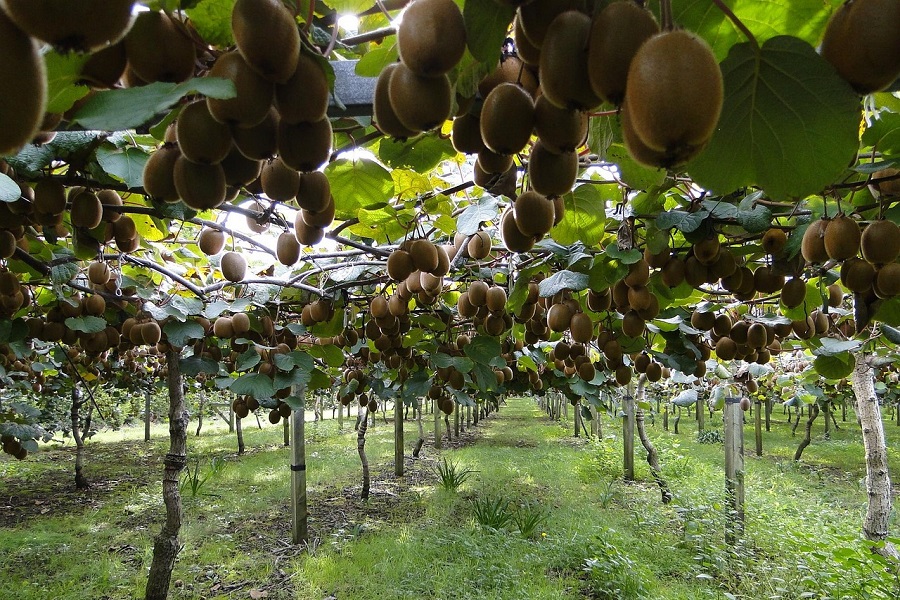
- T-bar: 2m height, economical (Rs 1.5L/acre)
- Per gola: Shade tolerant intercrops, higher yield
- Kniffin: Two-wire system for small farms
Pruning Schedule
- Year 1: Single leader to 1.8m
- Winter: Remove deadwood, thin canopy
- Summer: Pinch beyond 6-8 buds/fruiting arm
Pruning increases yield 25-30%, improves fruit size and quality.
Pests and Diseases in Kiwi Farming
Major Pests
| Pest | Symptoms | Control |
|---|---|---|
| Aphids | Curling leaves, honeydew | Neem oil 3ml/L |
| Leafroller | Webbing, skeletonized leaves | Bt 1g/L |
| Mites | Bronze leaves, webbing | Sulfur 2g/L |
| Thrips | Silvering, scarring | Spinosad 0.5ml/L |
Major Diseases
| Disease | Symptoms | Control |
|---|---|---|
| Root rot | Wilting, yellowing | Drainage + Trichoderma |
| Bacterial canker | Gum ooze, dieback | Copper oxychloride |
| Botrytis | Grey mold on fruits | Carbendazim + pruning |
Flowering and Fruiting Stage
Flowering: March-April, white fragrant flowers 3-5cm diameter. Dioecious (separate male/female vines).
Pollen Transfer: Honey bees essential. Plant males near females or use hand pollination in greenhouses.
Fruit Development: 140-180 days to maturity. Thin to 30-40 fruits/vine for large size.
Harvesting of Kiwi Fruit
Maturity Indicators
- TSS: 6.5-8.5°Brix
- Firmness: 6-8kg pressure
- Seeds: Fully black
- Soluble solids: Taste test
Harvest Method
Clip fruits with 2cm stalk using secateurs. Handle gently to avoid bruising. Harvest morning when cool.
Yield timing: Commercial harvest October-December (Himachal/Uttarakhand).
Yield of Kiwi Crop
| Plant Age | Kg/Plant | Tons/Acre | Tons/Hectare |
|---|---|---|---|
| Year 3 | 5-10 | 1-2 | 2.5-5 |
| Year 5 | 20-40 | 4-8 | 10-20 |
| Year 7+ | 50-100 | 10-15 | 25-37 |
Factors affecting yield: Variety, training, nutrition, pest control, thinning.
Storage and Marketing of Kiwi
Storage Methods
- Cold storage: 0-1°C, 90-95% RH = 4-6 months
- Controlled atmosphere: 2% O2, 5% CO2 = 8 months
- Room cooling: 10-13°C = 2-3 months
Market Channels
- Local mandis: Rs 150-250/kg
- Metro wholesale: Rs 200-350/kg
- Retail/export: Rs 400-600/kg
- Processing: Rs 80-120/kg
Cost of Kiwi Farming & Profit Margin
| Particulars | Cost (Rs/acre) |
|---|---|
| Land Preparation | 25,000 |
| Plants (170 @ Rs250) | 42,500 |
| Trellis System | 2,00,000 |
| Total Initial Investment | 3,50,000 |
| Annual Maintenance (Years 1-3) | 1,20,000 |
| Year 5+ Maintenance | 80,000 |
| Year 5+ Income (10 tons @ Rs200) | 20,00,000 |
| Net Profit/Year | 18,00,000 |
Payback period: 3-4 years. Benefit-cost ratio: 3.5:1
Advantages of Kiwi Cultivation
- High market price Rs200-500/kg
- Long economic life 35+ years
- Suitable for marginal hill lands
- 50-70% government subsidies
- Export potential to 20+ countries
- Multiple value-added products
- Low pesticide requirement
Government Schemes for Kiwi Farming
- NHM/MIDH: 50% subsidy on planting material
- HMNEH: 60% subsidy for NE states
- Himachal: Rs 1.25 lakh/acre assistance
- Uttarakhand: 70% up to Rs 12 lakh/project
- APEDA: Export promotion, packhouse subsidy
Contact: District Horticulture Officer for scheme applications.
Organic Kiwi Cultivation
Organic Inputs
- FYM/Vermicompost: 50kg/plant
- Biofertilizers: Azotobacter 10kg/acre
- Neem cake: 5kg/pit
Certification Process
- Register with APEDA/NPOP agency
- 3-year conversion period
- Annual inspection + residue testing
Organic kiwi fetches 25-40% premium prices.
Common Mistakes in Kiwi Farming
- Planting in waterlogged soils
- Insufficient male:female ratio
- Heavy pruning first 3 years
- Ignoring micronutrient sprays
- Delayed frost protection
- Poor trellis maintenance
FAQs – Frequently Asked Questions
1. Is kiwi farming profitable in India?
Yes, net returns of Rs 10-18 lakh/acre after year 4 make kiwi highly profitable.
2. How long does kiwi take to bear fruit?
First fruits appear in year 2-3, commercial yields from year 4-5 onwards.
3. Which soil is best for kiwi cultivation?
Sandy loam soil pH 5.5-6.5 with excellent drainage is ideal.
4. Can kiwi grow in plains of India?
No, kiwi requires cool temperate climate above 1200m altitude.
5. How much water does kiwi need?
800-1000mm annually. Drip irrigation recommended for efficiency.
6. What is the lifespan of kiwi vines?
Productive life 30-50 years with proper care.
7. Which kiwi variety is best for Himachal Pradesh?
Hayward and Allison give highest yields and market preference.
8. Does kiwi need pollination?
Yes, plant 1 male vine per 6-8 females. Honey bees essential.
9. What is kiwi farming cost per acre?
Initial investment Rs 3-4 lakh/acre, annual maintenance Rs 1 lakh.
10. When to prune kiwi vines?
Winter pruning (Dec-Jan) + summer pinching (June-July).
Conclusion
Kiwi farming offers Indian hill farmers a golden opportunity for high profits with relatively low risk. With proper variety selection, scientific management, and government support, returns of Rs 15-20 lakh per acre are realistic from year 5 onwards.
Start small with 1-2 acres, focus on quality Hayward or Allison grafts, install proper trellis, and follow IPM practices. Contact your local horticulture department for subsidies and training programs.
Ready to transform your hillside into a kiwi goldmine? The time to plant is now. Your successful kiwi orchard awaits!
Start your kiwi farming journey today and secure your family’s future with this high-value cash crop.