Walnut Farming in India: Complete Guide 2026 Cost, Profit & Cultivation
Walnut, known locally as Akhrot, stands as the most important temperate nut fruit in India. Cultivated across the cool, hilly terrains of Jammu & Kashmir, Himachal Pradesh, and Uttarakhand, this long-duration crop is prized for its high market value, nutritional richness, and the ability to generate income for generations. With India producing walnuts mainly in limited pockets, domestic supply remains low against rising demand, ensuring that growers consistently command strong prices.
The year 2026 marks a significant turning point for walnut cultivation in the country. The Union Budget 2026-27 has announced a dedicated programme for walnuts, almonds, and pine nuts in hilly regions, aiming to rejuvenate old, low-yielding orchards and expand high-density cultivation. This policy push, combined with world-class, high-yielding varieties developed by the ICAR-Central Institute of Temperate Horticulture (CITH) and successful post-harvest processing clusters established by SKUAST-Kashmir, makes walnut farming a compelling long-term investment for farmers in suitable climates. This guide provides a comprehensive, practical roadmap for farmers looking to capitalize on this growing opportunity.
📑 Table of Contents
- 1. Quick Crop Overview
- 2. About Walnut
- 3. Climate & Soil Requirement
- 4. Best Walnut Varieties for Cultivation
- 5. Propagation & Rootstock
- 6. Land Preparation & Planting
- 7. Irrigation Management
- 8. Month-wise Crop Calendar
- 9. Manure & Fertilizer Schedule
- 10. Intercropping & Weed Management
- 11. Training & Pruning
- 12. Pests and Diseases
- 13. Pollination Management
- 14. Harvesting & Post-Harvest Processing
- 15. Yield of Walnut
- 16. Storage & Marketing
- 17. Cost of Walnut Farming & Profit Margin
- 18. Advantages of Walnut Cultivation
- 19. Government Schemes & Support (2025-26)
- 20. Value-Added Products & Processing
- 21. Common Mistakes & Challenges
- 22. FAQs
- 23. Conclusion
1. Quick Crop Overview
| Parameter | Details |
|---|---|
| Scientific Name | Juglans regia |
| Family | Juglandaceae |
| Origin | Persia and Central Asia |
| Climate | Cool temperate; requires distinct winter chill |
| Ideal Temperature | Winter: 0°C to 7°C; Summer: 25°C–35°C |
| Chilling Requirement | 700–1,000 hours below 7°C |
| Soil & pH | Deep, well-drained loam; pH 6.0–7.5 |
| Planting Season | January–February (dormant bare-root plants) |
| Spacing | 8 m x 8 m to 10 m x 10 m |
| Plants per Acre | 60–70 plants |
| Bearing Age | Initial: 4-5 years; Economic: 6-7 years |
| Full Bearing Age | 10–12 years onwards |
| Harvesting Season | September – October |
| Yield Per Acre (Mature Orchard) | 1,000 – 1,500 kg |
| Economic Lifespan | 50+ years |
2. About Walnut
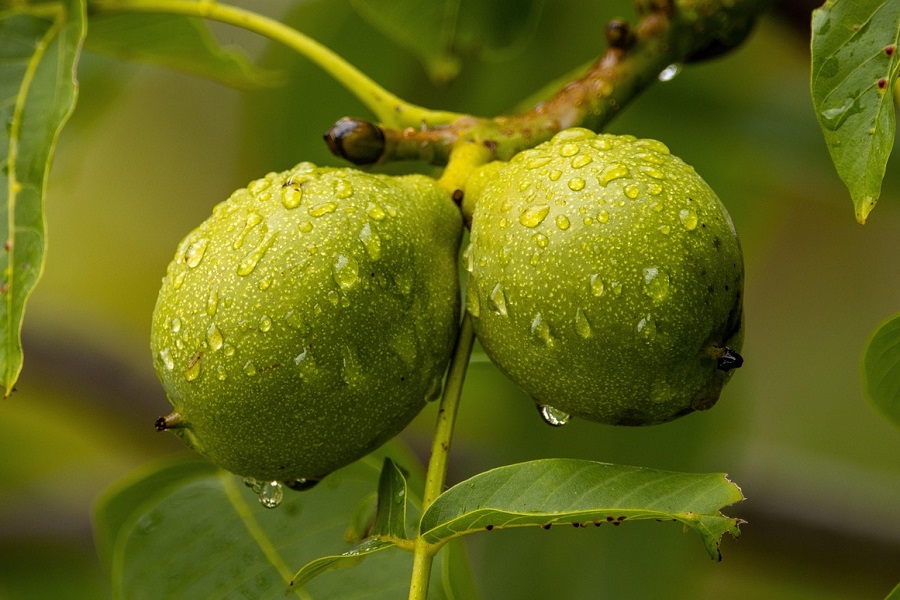
Walnut is a high-value deciduous nut crop that has been cultivated in the temperate Himalayas for centuries. The fruit consists of a hard, wrinkled shell enclosing the edible kernel, which is rich in healthy omega-3 fatty acids, antioxidants, protein, and essential vitamins and minerals. Indian walnuts are categorized by shell thickness into paper-shelled, thin-shelled, medium-shelled, and hard-shelled types.
Major Walnut Growing States in India (2026):
- Jammu & Kashmir: Occupies the largest share in total area and production. In FY24, the total area under cultivation was 86.44 thousand hectares, with production of 307.11 thousand tonnes. Key varieties include Lake English, Drainovsky, and Opex Caulchry. The Union Territory is also home to the ICAR-Central Institute of Temperate Horticulture (CITH) in Srinagar, which has developed world-record-size walnut varieties.
- Himachal Pradesh: Major varieties include Gobind, Eureka, Placentia, Wilson, Franquetfe, and Kashmir Budded. Cultivation is concentrated in the mid and high hills.
- Uttarakhand: Chakrata Selections are native to this region.
- Ladakh & North-East hill regions: Limited, experimental, or small-scale cultivation.
Market Demand & Export (2026): The demand for Indian walnuts remains strong due to their unique size and flavor. In FY24, India exported 2,134.22 MT of walnuts, valued at 7.80 USD million. Major export destinations include the United Arab Emirates, Turkey, Iraq, Singapore, and Algeria. The Union Budget 2026-27’s dedicated programme for nuts is expected to further boost export competitiveness.
3. Climate & Soil Requirement
🌤️ Climate for Walnut Cultivation
Walnut farming is strictly limited to cold and temperate regions. It is not suitable for warm plains or tropical zones, where it will result in poor flowering and crop failure.
- Winter Temperature (Chilling): Walnut has a high chilling requirement, needing 700 to 1,000 hours of temperatures below 7°C during winter dormancy to break bud and flower uniformly in spring.
- Growing Season: Requires a frost-free period during flowering in spring. Summers should be mild to warm (25°C–35°C) for nut development.
- Rainfall & Humidity: Prefers moderate rainfall and low humidity during nut development. High humidity can encourage fungal diseases.
- Sunlight: Requires full sunlight for optimal growth and yield.
🌱 Soil Requirement
- Best Soil Type: Deep, fertile, well-drained loam or sandy loam is ideal. Walnut trees develop a deep taproot, so soil depth of at least 2 meters is non-negotiable.
- Ideal pH: The optimum soil pH range is 6.0 to 7.5.
- Drainage: Excellent drainage is critical. Waterlogging leads to root rot and tree death.
- Avoid: Shallow soils, heavy clay, waterlogged land, and saline or alkaline soils.
Practical Tip: Before planting, conduct a deep soil test (up to 2 meters) to check for hard pans, drainage, and nutrient status. The government’s proposed Bharat-VISTAAR multilingual AI tool can assist in providing customized advisory support, including soil-related guidance.
4. Best Walnut Varieties for Cultivation
Choosing the right variety is the most critical decision for commercial success. Grafted plants of improved varieties are essential; seed-grown trees are not recommended as they are not true-to-type and have low yields.
High-Yielding Varieties from ICAR-CITH
The ICAR-Central Institute of Temperate Horticulture (CITH), Srinagar, has released five world-class walnut varieties (CITH W-1 to W-5) with superior nut and kernel characteristics, ideal for export.
| Variety | Key Characteristics | Special Features |
|---|---|---|
| CITH W-1 | Nut weight up to 28.0 g (largest in the world). Kernel weight 14.16 g. Kernel recovery 50.57%. Lateral bearing (51.78%). Yield up to 60 kg/tree. | Very large, soft-shelled nuts. Light kernel color. Tolerant to biotic stresses. Mid-season blooming. |
| CITH W-2 | Nut weight 21.90 g. Kernel recovery 51.27%. Yield up to 60 kg/tree. | Large nuts, well-filled kernels. Early-season blooming. |
| CITH W-3 | Nut weight 18.33 g. Kernel recovery 54.55%. Yield up to 40 kg/tree. | High kernel recovery. Late maturity. |
| CITH W-4 | Nut weight 19.43 g. Kernel recovery 59.39% (very high). Yield up to 45 kg/tree. Lateral bearing (25.35%). | Extremely high kernel recovery, thin shell, light kernel color. Late-season. |
| CITH W-5 | Nut weight 19.84 g. Kernel recovery 52.42%. Yield up to 50 kg/tree. Lateral bearing (29.31%). | Smooth shell, good kernel flavor. Late-season maturing. |
Important Note on Pollination: Walnut is cross-pollinated. To ensure proper pollination, these varieties must be planted in compatible groups with overlapping flowering times, such as CITH-W-1, W-3 & W-5, or CITH-W-2, W-4 & W-5.
Other Traditional Varieties
- Jammu & Kashmir: Lake English, Drainovsky, Opex Caulchry.
- Himachal Pradesh: Gobind, Eureka, Placentia, Wilson, Franquetfe, Kashmir Budded.
- Uttarakhand: Chakrata Selections.
Government Link: For more information on these high-yielding varieties and to obtain certified planting material, visit the official website of ICAR-Central Institute of Temperate Horticulture, Srinagar.
5. Propagation & Rootstock
Commercial walnut farming relies on grafting scions of high-yielding varieties onto hardy rootstocks.
- Rootstock: Seedlings of local walnut types (Juglans regia) are commonly used as rootstock. They should be raised from seeds collected from healthy, vigorous mother trees.
- Grafting: The recommended method is whip grafting or tongue grafting during the dormant season (January-February), just before the sap rises. This ensures true-to-type plants and early, uniform bearing.
- Certified Plants: Use only grafted plants from certified nurseries. Avoid seed-grown plants, as they result in highly variable nut quality and significantly longer waiting periods for yield.
Plants Required Per Acre: With a spacing of 8 m x 8 m, you will need approximately 60–70 plants per acre. High-density planting is not recommended for walnuts as they grow into large trees.
6. Land Preparation & Planting
Land Preparation
- Clearing & Deep Ploughing: Clear the land of stones, weeds, and previous crop residues. Conduct deep ploughing 2–3 times to break up compacted layers and improve aeration.
- Layout & Pit Digging: Mark the spots for pits based on chosen spacing (e.g., 8m x 8m). Dig pits of size 1 m x 1 m x 1 m during the summer (April-May). Leave pits open for sunlight exposure for 1–2 months to sterilize them.
- Pit Filling Mixture (per pit): Refill the pits 1–2 months before planting with a mixture of:
- Topsoil
- 20-25 kg well-decomposed Farm Yard Manure (FYM) or compost
- 1 kg Single Super Phosphate (SSP)
- 500 g Neem cake (for nematode/pest control)
- Biofertilizers (if available)
Water the pits to allow the mixture to settle.
Planting Method
- Best Planting Season: The dormant season, from January to February, is ideal for planting bare-root grafted plants. Avoid planting after bud swell.
- Planting Technique:
- Water the pits lightly a day before planting.
- Make a small hole in the center of the prepared pit.
- Place the grafted plant carefully, ensuring the graft union remains 5-7 cm above the final soil level.
- Spread the roots gently and fill the hole with soil, pressing firmly to eliminate air pockets.
- Create a basin around the plant and water immediately.
- Provide staking support to protect young trees from strong winds.
- Aftercare: Mulch around the base with organic material (straw, dry leaves) to conserve moisture and suppress weeds.
7. Irrigation Management
While walnut trees are deep-rooted and relatively drought-tolerant once established, consistent moisture is crucial for high yields and good nut quality, especially during nut filling.
Irrigation Schedule & Water Requirement
- Young Plants (Establishment Phase): Require frequent light irrigation during dry periods to ensure good root development.
- Growing Trees (Non-bearing): Irrigate at 10-15 day intervals during dry spells.
- Mature Trees (Bearing): The most critical stage for irrigation is during nut filling (summer months). Avoid water stress during this period, as it can lead to small nuts and poor kernel fill.
- Drip Irrigation: Highly recommended for efficient water use and improved yield. It delivers water directly to the root zone, minimizing wastage.
- Avoid: Over-irrigation and waterlogging, which can lead to root rot diseases.
Government Link: For details on subsidies for micro-irrigation, visit the official PMKSY (Per Drop More Crop) website. The scheme provides financial assistance for installing drip/sprinkler systems.
8. Month-wise Crop Calendar
(Based on conditions in Jammu & Kashmir and Himachal Pradesh)
| Month | Growth Stage / Operation |
|---|---|
| January – February | Dormancy & Pruning. Plant bare-root grafted trees. Annual pruning of established trees. Apply dormant sprays for pest/disease control. |
| March – April | Bud Break & New Growth. Watch for late frost damage. Apply first split of nitrogen fertilizers. |
| May – June | Flowering & Fruit Set. Ensure adequate soil moisture. Monitor for pests like aphids. |
| July – August | Nut Development & Filling. Critical irrigation period. Monitor for codling moth and walnut blight. |
| September – October | Harvesting. Harvest mature nuts from ground after they fall. Hulling, washing, and drying. |
| November – December | Post-Harvest & Leaf Fall. Orchard sanitation. Apply FYM. Prepare for winter dormancy. |
9. Manure & Fertilizer Schedule
Walnuts are heavy feeders. A balanced nutrition plan based on soil testing is essential for sustained high yields.
Annual Fertilizer Schedule (Per Tree, for Mature Trees)
| Time of Application | FYM (kg) | N (g) | P₂O₅ (g) | K₂O (g) |
|---|---|---|---|---|
| November – December (Post-harvest) | 30-50 | – | – | – |
| March (Bud break) | – | 500-600 | – | – |
| April – May (After fruit set) | – | 300-400 | 300-400 | 400-500 |
Micronutrients: Zinc and boron are particularly important for walnut quality. Soil testing every 2–3 years is strongly recommended to guide nutrient applications. Foliar sprays of ZnSO4 (0.5%) and Borax (0.2%) can be applied if deficiencies are observed.
10. Intercropping & Weed Management
🌾 Intercropping
During the first 5-7 years, when walnut trees are widely spaced, intercropping provides additional income and optimizes land use.
- Suitable Intercrops:
- Legumes: Beans, peas, lentils – these fix nitrogen and improve soil health.
- Vegetables: Potatoes, leafy greens, carrots (in partial shade).
- Fodder crops: Oats, berseem.
- Medicinal & Aromatic Plants: Saffron, lavender (high-value options).
- Benefits: Additional income, weed suppression, and soil fertility improvement.
- Caution: Avoid tall crops that can shade the young walnut trees. Stop intercropping once the walnut canopy expands significantly.
🌿 Weed Management
- Mulching: Organic mulch (paddy straw, pine needles, dry leaves) applied around the tree basin is highly effective for moisture conservation and weed suppression.
- Manual Weeding: Regular weeding (3-4 times a year) in the tree basins and inter-row spaces.
- Herbicides: Use as a last resort. Glyphosate can be used as a directed spray on emerged weeds, taking care to avoid any contact with walnut foliage or green bark.
11. Training & Pruning
Proper training in the early years and annual pruning are key to developing a strong tree framework and maintaining productivity.
- Training (First 3-4 Years): The central leader system is often preferred for walnuts. Select a single, strong central trunk and encourage well-spaced whorls of 3-4 main branches. Remove competing leaders.
- Annual Pruning (Mature Trees – Winter Dormancy):
- Remove all dead, diseased, damaged, and crossing branches.
- Remove water sprouts and suckers.
- Thin out crowded branches to improve light penetration and air circulation throughout the canopy.
- Benefits of Pruning: Develops a strong structure, maintains tree health, improves nut size and quality, and reduces disease pressure.
12. Pests and Diseases
Good orchard sanitation, pruning, and drainage prevent most problems.
Major Pests
- Codling Moth: The most destructive pest. Larvae bore into the nuts, feeding on the kernel and causing premature nut drop. Control: Use pheromone traps for monitoring and mating disruption. Spray insecticides like chlorantraniliprole at the appropriate time. Maintain clean orchard floor by removing fallen nuts.
- Walnut Aphid: Sucks sap from leaves and tender shoots, causing leaf curling and sooty mold. Control: Encourage natural predators like ladybird beetles. Spray with neem-based insecticides or dimethoate if infestation is severe.
- Stem Borers: Larvae bore into the trunk and main branches, causing dieback. Control: Maintain tree vigor. Remove and destroy affected branches. Insert dichlorvos-soaked cotton into active holes and seal with mud.
Major Diseases
- Walnut Blight (Xanthomonas): A bacterial disease that causes black lesions on nuts, shoots, and leaves, leading to nut drop and kernel rot. Control: Use resistant varieties. Apply copper-based bactericides (Bordeaux mixture) during bud break and flowering.
- Root Rot (Armillaria/Phytophthora): Caused by poor drainage or waterlogging. Symptoms include yellowing leaves and sudden wilt. Control: Ensure excellent drainage. Avoid planting in infested soils. Remove and destroy infected trees.
- Anthracnose: Fungal disease causing leaf spots and defoliation, leading to poor nut fill. Control: Prune for better air circulation. Apply fungicides like Mancozeb or Chlorothalonil.
13. Pollination Management
Understanding walnut pollination is critical for yield. Walnut trees are monoecious (separate male and female flowers on the same tree) but often exhibit dichogamy-male and female flowers on the same tree mature at different times to promote cross-pollination.
- Cross-Pollination is Essential: Most walnut varieties benefit significantly from cross-pollination by a compatible pollinizer variety.
- Planting in Groups: The world-class CITH varieties must be planted in compatible groups with overlapping flowering times to ensure good nut set. For example, one recommended group is CITH-W-1, CITH-W-3 & CITH-W-5.
- Pollination Agent: Wind is the main agent for walnut pollination. Therefore, proper orchard layout with pollinizer varieties placed throughout the orchard is crucial.
- Ignoring pollination is a major reason for low yields in walnut orchards.
14. Harvesting & Post-Harvest Processing
Harvesting
- When to Harvest: Walnuts are ready for harvest from September to October. The main indicator is the splitting of the green hull (husk) around the nut. Mature nuts are often collected from the ground after they fall.
- Harvesting Method: Nuts can be shaken from the tree onto clean tarps or collected from the ground daily. Frequent collection prevents mold and pest infestation.
Post-Harvest Processing – A Game Changer for Profitability
Traditional post-harvest handling was a major bottleneck for walnut growers. However, a landmark project by SKUAST-Kashmir, funded by the Department of Biotechnology (DBT), has established model mechanized walnut processing units in Kupwara district.
- Mechanized Processing: These units include facilities for dehulling, washing, drying, grading, and packaging. This has transformed the value chain.
- Impact on Farmers: Growers who used these facilities saw their handling capacity increase from 12-15 quintals to 30-35 quintals, and their annual earnings rose from ₹5 lakh to ₹12 lakh.
- Government Scaling Up: Given the excellent performance, the DBT has recommended setting up 6–8 more such units in other walnut-growing districts of J&K.
Practical Tip: After harvest, walnuts must be properly dried to reduce moisture content to below 8% for safe storage. Sun drying on clean floors or using mechanical dryers is common. Well-dried walnuts have a much longer shelf life and better kernel quality.
Government Link: For information on post-harvest technologies and training, farmers can contact the Sher-e-Kashmir University of Agricultural Sciences and Technology of Kashmir (SKUAST-K).
15. Yield of Walnut
Yield is highly dependent on variety, tree age, management, and pollination success.
- Year 1-4: No commercial yield. Trees focus on vegetative growth and establishment.
- Year 5-7: Initial economic yields, ranging from 300-500 kg per acre.
- Year 10 onwards (Full Bearing): A well-managed mature orchard can yield 1,000 to 1,500 kg per acre. Premium orchards with high-yielding varieties like CITH-W-1 can exceed this, with some trees yielding up to 60 kg individually.
16. Storage & Marketing
Storage Methods
- In-shell Walnuts: After proper drying, in-shell walnuts can be stored for several months in cool, dry, well-ventilated conditions. They are often stored in mesh bags to allow air circulation.
- Shelled Kernels: Kernels are more perishable. They should be stored in vacuum packaging or in cool, dark conditions to prevent rancidity. Cold storage at low temperatures extends shelf life significantly.
Marketing Channels & Price (2026 Outlook)
- Local APMC Mandis: Traditional marketing channel in J&K, HP, and Uttarakhand. Prices are determined by quality (size, color, kernel fill, shell thickness).
- Wholesale Traders & Processors: Selling directly to large traders or processing companies can provide stable market access, especially for graded produce.
- Export: A lucrative channel for premium, graded, thin-shelled walnuts (like the CITH varieties). India’s major export destinations are UAE, Turkey, Iraq, and Singapore.
- Farmer Producer Organizations (FPOs): FPOs can aggregate produce, invest in small-scale processing units (like the SKUAST-K model), and negotiate better prices for their members.
- Market Price (2026):
- In-shell walnuts: ₹250–400 per kg.
- Shelled walnut kernels: ₹800–1,200 per kg or higher.
- Premium, graded walnuts (e.g., extra-large, light-colored kernels) command significantly higher prices.
17. Cost of Walnut Farming & Profit Margin
Disclaimer: These are estimates for 1 acre based on 2025-26 data. Actual figures vary by region, variety, input costs, management, and market prices.
Assumptions: 8m x 8m spacing (65 plants), grafted plants, mature orchard (10+ years).
A. Initial Investment (Years 1-7 – Orchard Establishment)
| Component | Cost (₹) |
|---|---|
| Land preparation & pit digging | 25,000 |
| Cost of grafted plants (65 @ ₹250-400) | 22,000 |
| FYM and fertilizers (first 7 years) | 70,000 |
| Irrigation setup & maintenance | 30,000 |
| Labour, weeding, intercropping expenses | 70,000 |
| Total Investment (Years 1-7) | ₹ 2,17,000 |
Note: Initial investment is often cited in the range of ₹2–3 lakh per acre.
B. Annual Maintenance Cost (From Year 8 onwards)
| Component | Cost (₹/year) |
|---|---|
| Fertilizers & Manure | 15,000 |
| Plant protection chemicals | 8,000 |
| Labour (pruning, spraying, irrigation) | 15,000 |
| Irrigation (electricity) | 5,000 |
| Harvesting, processing & packing | 15,000 |
| Total Annual Cost | ₹ 58,000 |
Note: Annual maintenance costs are estimated between ₹40,000–60,000 per acre.
C. Income from Mature Orchard (Year 10 onwards)
Based on average yields and market prices.
| Parameter | Conservative Estimate | Well-Managed Orchard |
|---|---|---|
| Yield per acre | 1,000 kg | 1,500 kg |
| Average price (in-shell) | ₹ 300 per kg | ₹ 350 per kg |
| Gross Income | ₹ 3,00,000 | ₹ 5,25,000 |
D. Profit Calculation (Mature Orchard)
| Parameter | Conservative (₹) | Optimistic (₹) |
|---|---|---|
| Gross Income | 3,00,000 | 5,25,000 |
| Annual Maintenance Cost | 58,000 | 60,000 |
| Net Profit Per Year | ₹ 2,42,000 | ₹ 4,65,000 |
Important Notes:
- Value Addition: Shelling and grading kernels can increase profit significantly. The SKUAST-K model showed farmers’ earnings more than doubling with access to processing facilities.
- Subsidy Impact: The new dedicated government programme for nuts can help reduce the initial investment burden and support orchard rejuvenation.
- Break-even: Given the long gestation period, the initial investment is typically recovered by the 10th or 11th year. The orchard then generates substantial profit for 40+ years.
18. Advantages of Walnut Cultivation
- High, Stable Profitability: Limited domestic supply and rising health-conscious demand ensure high market prices and strong net profits (₹2-4.5 lakhs per acre) for mature orchards.
- Multi-Generational Income: An extremely long economic lifespan of 50+ years makes a walnut orchard a legacy asset for a farming family.
- Climate Suitability: Perfectly suited to the temperate agro-climatic conditions of North-Western Himalayas, where few other high-value crops thrive.
- High Demand & Export Potential: Growing domestic and international demand, with India already exporting to the Middle East and Southeast Asia.
- Government Support (2026): A dedicated government programme for nuts in hilly regions has been announced to rejuvenate old orchards and promote high-density cultivation.
- Improved Varieties & Processing: Access to world-record-size varieties from ICAR-CITH and successful mechanized processing clusters from SKUAST-K has transformed the value chain.
- Value Addition Opportunities: Potential for high-value products like shelled kernels, walnut oil, and kernel-based confectionery.
19. Government Schemes & Support (2025-26 Update)
Several government initiatives support walnut farmers. Key developments for 2025-26 include:
- Union Budget 2026-27: Dedicated Programme for Nuts: This is the most significant announcement for walnut growers. The government will support a dedicated programme to rejuvenate old, low-yielding orchards and expand high-density cultivation of walnuts, almonds, and pine nuts in hilly regions. The aim is to enhance farmer incomes and bring value addition by engaging youth.
- MIDH (Mission for Integrated Development of Horticulture): The central scheme for horticulture development. It provides financial assistance for area expansion (new orchards), planting material, and creation of water resources. The new dedicated nut programme is likely to be implemented through or in conjunction with MIDH. For more details, visit the official MIDH website.
- PMKSY (Per Drop More Crop): Provides subsidies for installing micro-irrigation (drip/sprinkler) systems: 55% for small and marginal farmers and 45% for other farmers.
- DBT-SKUAST-K Processing Clusters: Following the grand success of the walnut processing cluster project in Kupwara, the Department of Biotechnology (DBT) has recommended setting up 6–8 more such units in other walnut-growing districts of J&K. This presents a massive opportunity for FPOs and farmer groups to access mechanized post-harvest infrastructure.
- Bharat-VISTAAR: A new multilingual AI-based platform integrating AgriStack portals and ICAR practices. It will provide customised advisories on crop planning, pest management, and market intelligence to help farmers reduce risks and improve decision-making.
How to Apply: Farmers can apply for MIDH and PMKSY subsidies through the State Horticulture Mission or their local District Horticulture Officer. Information on the new nut programme will be disseminated through these channels as it is rolled out.
20. Value-Added Products & Processing
Moving up the value chain can significantly increase a farmer’s income from walnuts. The SKUAST-K model has already demonstrated how access to processing can more than double farmer earnings.
- Shelled Walnut Kernels: The most common value-added product. Kernels are graded by size (halves, pieces) and color (light, amber). Light-colored, whole halves command the highest price.
- Walnut Oil: A premium, cold-pressed oil used in gourmet cooking and cosmetics. It has a high market value.
- Walnut Flour/Powder: Used in baking and confectionery.
- Candied Walnuts: A snack product with good market potential.
- Walnut-based Snacks & Sweets: Incorporated into traditional Indian sweets and confectionery.
- Green Walnut Pickle: A specialty product made from immature nuts in some regions.
Government Link: For training on walnut processing and value addition, farmers can contact the SKUAST-K or their local KVK.
21. Common Mistakes & Challenges
- Planting in Unsuitable Climate: Attempting to grow walnuts in warm plains or regions without sufficient winter chill (700-1000 hours).
- Poor Variety Selection: Planting seed-grown trees or low-yielding local varieties instead of grafted, improved, high-yielding varieties like the CITH series.
- Inadequate Soil Depth: Planting in shallow or rocky soils that restrict taproot development.
- Ignoring Pollination: Planting a single variety without considering the need for compatible pollinizers, leading to poor fruit set.
- Improper Spacing: Planting too densely leads to overcrowding, competition for light, and reduced yields.
- Neglecting Pruning: Failure to prune annually leads to tangled canopies, reduced nut quality, and higher disease pressure.
- Poor Orchard Floor Management: Not controlling weeds or not harvesting fallen nuts frequently, leading to pest and disease harborage.
- Lack of Post-Harvest Infrastructure: Inadequate drying and storage facilities lead to quality deterioration and mold, fetching lower prices.
- Expecting Quick Returns: Walnut farming requires patience. It is a slow-build, long-term investment that punishes impatience.
- Not Joining FPOs: Individual farmers miss out on the benefits of collective bargaining and access to processing infrastructure.
22. FAQs – Frequently Asked Questions
Q1. Is walnut farming profitable in India?
A: Yes, walnut farming is highly profitable in suitable temperate climates. A mature, well-managed orchard can yield a net profit of ₹2-4.5 lakhs per acre. Value addition through processing can further increase profitability.
Q2. How many years does a walnut tree take to bear fruit?
A: Grafted walnut plants start bearing a small crop from the 4th or 5th year after planting. Commercial yields begin from the 6th-7th year, and full production is achieved by the 10th-12th year.
Q3. What is the yield of a walnut tree?
A: A mature, well-managed tree (10+ years) can yield 40-60 kg of nuts per year. High-yielding varieties like CITH-W-1 have the potential to yield up to 60 kg per tree.
Q4. Which is the best walnut variety for commercial farming?
A: The CITH-W series (W-1 to W-5) developed by ICAR-CITH, Srinagar, are world-class varieties with very large nut size (up to 28g) and high kernel recovery (up to 59%). They are ideal for domestic and export markets. However, they must be planted in compatible groups for pollination.
Q5. What is the climate requirement for walnut farming?
A: Walnut requires a cool temperate climate with distinct seasons. It needs 700-1,000 chilling hours (temperatures below 7°C) during winter and a frost-free period in spring. It is only suitable for hilly regions like J&K, HP, and Uttarakhand.
Q6. What soil is best for walnut cultivation?
A: Deep, well-drained, fertile loam soils with a minimum depth of 2 meters and a pH of 6.0-7.5 are ideal.
Q7. What is the lifespan of a walnut tree?
A: With proper care and management, a walnut tree has a very long economic lifespan of over 50 years.
Q8. What is the market price for walnuts?
A: In 2026, in-shell walnuts typically range from ₹250-400 per kg. Shelled kernels fetch ₹800-1,200 per kg or more, depending on grade and quality.
Q9. What government schemes are available for walnut farming in 2026?
A: The Union Budget 2026-27 has announced a dedicated programme for rejuvenating old orchards and expanding cultivation of nuts (walnuts, almonds) in hilly regions. Farmers can also avail benefits under MIDH and PMKSY. The DBT is also scaling up successful walnut processing clusters in J&K.
Q10. Where can I get high-quality walnut plants?
A: Certified, grafted plants of improved varieties can be obtained from the ICAR-Central Institute of Temperate Horticulture (CITH), Srinagar, and other government-recommended nurseries in J&K, HP, and Uttarakhand.
23. Conclusion
Walnut farming in India is not a venture for the impatient. It is a slow-build, high-stability agricultural investment that rewards long-term vision with decades of premium income. With India’s domestic production lagging far behind demand, and with walnuts being recognized as a high-value crop by the government in the Union Budget 2026-27, the future for growers in temperate regions has never been brighter.
The sector is being transformed by science and policy. The release of world-record-size varieties by ICAR-CITH gives Indian farmers the genetic potential to compete in the global market. The establishment of mechanized processing clusters by SKUAST-Kashmir has demonstrated a clear path to more than doubling farmer incomes through value addition. The government’s new dedicated programme for nuts promises to bring much-needed support for orchard rejuvenation and expansion.
Success in walnut cultivation hinges on strict adherence to fundamentals. It requires planting only in suitable, cold climates with deep, well-drained soils. It demands the use of certified, grafted plants of improved varieties and a clear understanding of their pollination requirements. And it requires patience, meticulous pruning, and a long-term view.
For farmers in the right geography, a walnut orchard is more than just a crop-it is a legacy asset that can provide financial security for generations. By combining the power of improved varieties, modern management techniques, and the new wave of government support, Indian farmers are poised to transform the nation’s walnut sector and capture a larger share of this valuable global market.
Ready to start your Walnut Farming?
Are you in a suitable temperate region? Begin by getting your soil tested to ensure it is deep and well-drained. Visit a successful orchard and consult with your local District Horticulture Officer to understand the roll-out of the new government programme for nuts. For the highest quality planting material, contact the ICAR-CITH, Srinagar or a certified nursery. Consider forming or joining an FPO to collectively access the kind of processing infrastructure being promoted by DBT and SKUAST-K. With the right preparation and a long-term commitment, your walnut orchard can become a source of prosperity for your family and generations to come.
Disclaimer: The information provided in this guide is for general informational purposes. The costs, yields, profits, and cultivation practices mentioned are estimates and may vary significantly based on location, soil conditions, climate, management practices, and dynamic market factors. It is strongly recommended that farmers consult with local agricultural experts, KVKs, and state horticulture departments before making any investment decisions. This website and its authors disclaim any liability for financial losses or crop failures resulting from the use of this information.