Watermelon Farming in India: Complete Cultivation Guide 2026
Watermelon, known locally as Tarbuj or Kalingad, is one of India’s most popular summer fruits, offering farmers a quick-income option with a short crop duration of just 70-80 days. With India being a major producer, states like Gujarat, Maharashtra, Tamil Nadu, Uttar Pradesh, and Karnataka lead in cultivation. The year 2026 has started on a strong note for watermelon growers, with Gujarat’s Mahuva region leading a robust export season, shipping 500-600 containers to the Middle East, where Ramadan fasting drives additional demand .
For the Indian farmer, watermelon represents a high-return opportunity with relatively low investment. Success stories abound, from Tamil Nadu farmers earning seven times their investment through precision farming and drip irrigation to Punjab farmers netting ₹1.7-2 lakh per acre with premium hybrid varieties . The Indian Council of Agricultural Research (ICAR) and its institutes like the Indian Institute of Horticultural Research (IIHR), Bengaluru, have released improved, disease-resistant varieties like Arka Manik, which offers triple resistance to powdery mildew, downy mildew, and anthracnose, ensuring yields of 60 tonnes per hectare . This comprehensive guide provides everything you need to know about starting and managing a profitable watermelon crop in 2026.
📑 Table of Contents
- 1. Quick Crop Overview
- 2. About Watermelon
- 3. Climate & Soil Requirement
- 4. Best Watermelon Varieties for Cultivation
- 5. Seed Rate & Sowing
- 6. Land Preparation & Planting
- 7. Irrigation Management
- 8. Month-wise Crop Calendar
- 9. Manure & Fertilizer Schedule
- 10. Intercropping & Weed Management
- 11. Pests and Diseases
- 12. Harvesting of Watermelon
- 13. Yield of Watermelon
- 14. Post-Harvest Storage & Marketing
- 15. Export of Indian Watermelons
- 16. Cost of Watermelon Farming & Profit Margin
- 17. Advantages of Watermelon Cultivation
- 18. Government Schemes & Support (2025-26)
- 19. Value-Added Products & Processing
- 20. Common Mistakes & Challenges
- 21. FAQs
- 22. Conclusion
1. Quick Crop Overview
| Parameter | Details |
|---|---|
| Scientific Name | Citrullus lanatus |
| Family | Cucurbitaceae |
| Origin | Southern Africa |
| Climate | Tropical and subtropical; warm, frost-free |
| Ideal Temperature | 25°C – 35°C (germination), 20°C – 30°C (growth) |
| Soil & pH | Well-drained sandy loam, riverbed soils; pH 6.0 – 7.5 |
| Planting Season | December – February (summer crop), June – July (monsoon crop) |
| Sowing Method | Direct seeding on raised beds or pits |
| Spacing | 1.5 m – 2.0 m (row to row) x 0.6 m – 0.9 m (plant to plant) |
| Seed Rate | 2.5 – 3.5 kg per hectare |
| Days to Maturity | 70 – 100 days (variety-dependent) |
| Harvesting Season | March – June (summer crop), September – October (monsoon crop) |
| Average Yield per Hectare | 50 – 80 tonnes (improved varieties/hybrids) |
| Average Yield per Acre | 20 – 32 tonnes |
2. About Watermelon
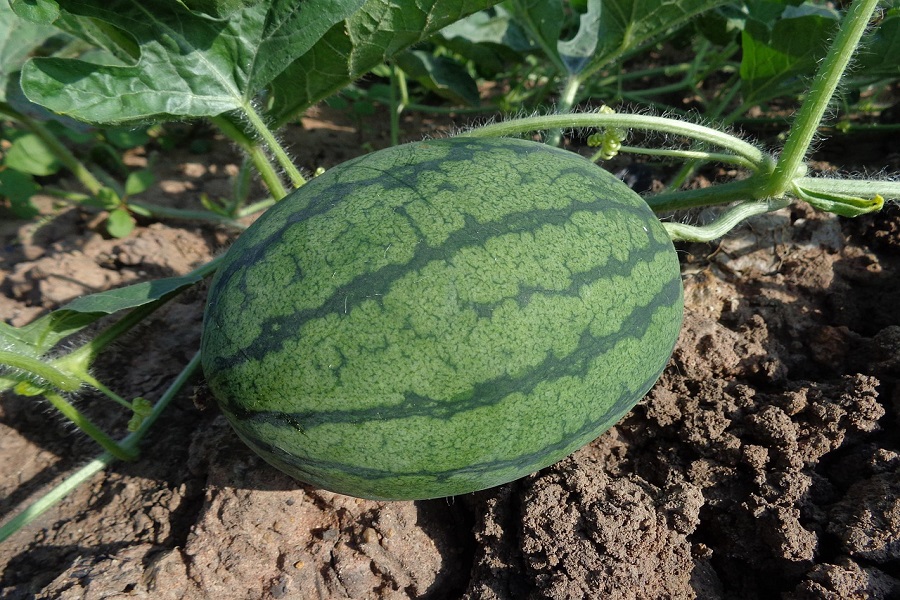
Watermelon is a warm-season crop belonging to the cucurbit family, prized for its juicy, sweet, refreshing flesh which is over 90% water. It is rich in lycopene, vitamin A, vitamin C, and amino acids. The fruit varies in size, shape, and color, from the traditional large, oblong green-striped fruits to newer ice-box types weighing 2-3 kg . India is a major global producer, with watermelon cultivation spread across the country.
Major Watermelon Growing States in India (2026):
- Gujarat: Leading producer, especially Mahuva (Bhavnagar), Junagadh, Mehsana, and Sabarkantha districts. Gujarat watermelons, particularly the Bahubali variety, are the mainstay of India’s export boom to the Middle East .
- Maharashtra: Significant production in Solapur, Pune, Ahmednagar, and Parbhani districts. However, in Parbhani’s Selu taluka, price uncertainty led to a 600-acre drop in cultivation area in 2026 compared to the previous year, highlighting market risks .
- Tamil Nadu: Major cultivation in Villupuram district (9,000 acres), along with Marakanam, Vanur, and Olakkur blocks. Thiruvannamalai district farmers have excelled with precision farming and drip irrigation .
- Uttar Pradesh: Large-scale cultivation in riverbeds and plains.
- Karnataka, Andhra Pradesh, Telangana, Punjab, Rajasthan: Significant production in suitable pockets. Punjab farmer Gurnam Singh Mutti successfully cultivates premium watermelon varieties on 22 acres .
- Ladakh (Emerging Region): The Defence Institute of High Altitude Research (DIHAR) has demonstrated successful watermelon cultivation in open fields using black plastic mulch, with a benefit-cost ratio of 3.40. The produce is even supplied to the army ration .
Market Demand (2026): The watermelon market is robust, driven by summer thirst and export opportunities. In early 2026, Gujarat led a strong export season, with 500-600 containers shipped to the Middle East, where Ramadan fasting boosts demand . Domestic wholesale prices have risen 20-30% per kg from the previous year due to a favorable supply-demand balance .
3. Climate & Soil Requirement
🌤️ Climate for Watermelon Cultivation
Watermelon is a warm-season crop that requires a long, hot, and frost-free growing period. It is sensitive to cold and frost, which can damage plants and reduce yields.
- Temperature: Ideal temperature for seed germination is 25°C – 35°C. For vegetative growth and fruit development, the ideal range is 20°C – 30°C. Temperatures below 15°C slow growth, and frost is fatal.
- Rainfall: Requires low to moderate rainfall. High humidity and rainfall during flowering and fruit set can lead to poor fruit set and increased disease incidence (powdery mildew, downy mildew).
- Sunlight: Requires full, bright sunlight throughout the day for optimal growth, flowering, and fruit development.
- Dry Period: A dry period during fruit maturation is essential for high sugar content and good quality. Rain near harvest can cause fruit rot and dilute sweetness .
🌱 Soil Requirement
- Best Soil Type: Well-drained sandy loam soils are ideal. Watermelon is also successfully cultivated in riverbeds and sandy soils, which warm up quickly in spring. Heavy clay soils with poor drainage are unsuitable as they can lead to root rot.
- Ideal pH: The optimum soil pH range is 6.0 to 7.5 (slightly acidic to neutral).
- Drainage: Excellent drainage is critical. Watermelon is highly susceptible to waterlogging. Raised beds are recommended, especially in heavier soils or high-rainfall areas.
- Soil Preparation Tip: Plough the field 3-4 times to bring the soil to a fine tilth. Incorporate well-decomposed FYM (25 tonnes/ha) during the final ploughing .
4. Best Watermelon Varieties for Cultivation
Choosing the right variety is crucial for commercial success. Selection should be based on market demand (export vs. local), disease resistance, and regional adaptability.
High-Yielding Varieties from ICAR-IIHR, Bengaluru
The Indian Institute of Horticultural Research (IIHR) has released several improved varieties suitable for different purposes .
| Variety | Key Characteristics | Yield (t/ha) | Special Features |
|---|---|---|---|
| Arka Manik | Fruits oval (6 kg avg.), light green rind with dark green stripes, deep crimson flesh, granular texture, pleasant aroma, very sweet (TSS 12-15°Brix). Seeds small . | 60 t/ha | Triple resistant to powdery mildew, downy mildew, and anthracnose. Can be grown year-round in subtropical conditions, breaking seasonal barriers . Economic returns ₹50-60,000/ha in 110 days . |
| Arka Muthu | Shorter internodal length, early maturing (75-80 days). Round fruits with dark green stripes, deep red flesh. Ice-box type, avg. fruit weight 2.5-3 kg. TSS 12-14°Brix . | 50-60 t/ha | Suitable for precision farming and high-density planting . |
| Arka Aiswarya | High-yielding F1 hybrid. Fruits oblong, red flesh, sweet taste. TSS 12-13°Brix . | 80 t/ha | High yield potential. |
| Arka Akash | High-yielding F1 hybrid. Fruits round to oval, light green with dark green stripes, red flesh. TSS 12°Brix . | 75-80 t/ha | Good yield and quality. |
Other Commercial Varieties & Hybrids
- Bahubali: The top export variety from Gujarat. Fruits average 2 kg, 3-4 inches across, with consistent sizing. Preferred for export due to smaller size, better shelf life, and suitability for air/sea freight. Far more popular than local black varieties .
- Jannat, Mannat, Vishala, Aarohi: Premium varieties grown by innovative farmers like Gurnam Singh Mutti in Punjab. Jannat has tomato-red flesh with light green skin; Mannat has red flesh with dark green skin; Vishala is red inside with yellow outside; Aarohi has striking black skin and yellow-red flesh .
- Pukeeza (Numhems) & Apoorva (Seminis): Varieties used successfully in precision farming in Tamil Nadu. Farmer Muruga Perumal achieved 55 tonnes/ha from Pukeeza and 61 tonnes/ha from Apoorva .
- Mateera Varieties (for Arid Regions): ICAR-CIAH, Bikaner has developed varieties like AHW-19 and Thar Manak for hot arid climates. These are early harvesting, produce better quality fruits, and are of multiple-use, recommended for resource-constrained conditions .
Practical Tip: For export markets, plant Bahubali for its consistent sizing and shelf life. For high disease resistance and excellent quality, choose Arka Manik. For premium local markets, experiment with visually appealing varieties like Aarohi or Vishala.
Government Link: For detailed information on ICAR-IIHR varieties and to obtain certified seeds, visit the official website of the Indian Institute of Horticultural Research, Bengaluru.
5. Seed Rate & Sowing
- Seed Rate:
- Open-pollinated varieties: 3.0 – 3.5 kg per hectare.
- Hybrid varieties: 2.5 – 3.0 kg per hectare (seeds are more expensive but offer higher yields).
- Seed Treatment: Treat seeds with Carbendazim 2 g/kg of seeds before sowing to protect against soil-borne fungal diseases .
- Sowing Time:
- Summer crop: December – February (sown in November-December in Tamil Nadu ).
- Monsoon crop: June – July.
- Sowing Method: Direct sowing on raised beds or pits. In precision farming, seeds are sown at each dripper location .
6. Land Preparation & Planting
Land Preparation
- Ploughing: Plough the field 3-4 times to bring the soil to a fine tilth. Before the final ploughing, incorporate well-decomposed FYM at the rate of 25 tonnes per hectare .
- Basal Fertilizer Application: Apply 300 kg DAP and 150 kg Potash per hectare as a basal dose before leveling .
- Forming Raised Beds (Recommended): Form raised beds of 1.5 m width at an interval of 60 cm. For drip irrigation, place laterals on the centre of each bed at the rate of 1 lateral pipe per 5 feet .
- Pre-Sowing Irrigation: Irrigate the beds for a few minutes before sowing to create a moist environment for germination .
- Sowing: Sow 2-3 seeds per hill at a depth of 2-3 cm. Thin to one healthy seedling per hill after germination. Spacing:
- Row to row: 1.5 – 2.0 m
- Plant to plant: 0.6 – 0.9 m
7. Irrigation Management
Watermelon requires consistent moisture, especially during the early growth, flowering, and fruit development stages. However, it is sensitive to waterlogging. Drip irrigation is highly recommended for water efficiency, higher yields, and reduced disease incidence.
Irrigation Schedule & Water Requirement
- Germination & Seedling Stage: Keep the soil moist. Light, frequent irrigation.
- Vegetative Growth & Flowering: Irrigate at 3-5 day intervals, depending on soil type and weather.
- Fruit Development: This is the most critical stage. Consistent moisture is essential for proper fruit sizing. Moisture stress can lead to small, misshapen fruits.
- Ripening Stage: Reduce irrigation as fruits approach maturity. Excess water during ripening can dilute sugar content and increase the risk of fruit cracking and rot.
- Drip Irrigation & Fertigation: In precision farming, drip irrigation with fertigation is highly successful. Farmer Muruga Perumal in Tamil Nadu irrigated one hour per day through drip and applied 5 kg Potassium Nitrate and 5 kg Urea at 3-day intervals by fertigation throughout the cropping period .
Government Link: For details on subsidies for micro-irrigation, visit the official PMKSY (Per Drop More Crop) website. The scheme provides financial assistance for installing drip/sprinkler systems.
8. Month-wise Crop Calendar
(For the main summer crop, sown in December-January)
| Month | Growth Stage / Operation |
|---|---|
| November | Land preparation, FYM incorporation. Formation of raised beds. Laying of drip laterals (if using). |
| December | Sowing. Seed treatment and sowing. First irrigation. Germination occurs within 5-7 days. |
| January | Vegetative Growth. Thinning, weeding, and fertilizer application (basal). Begin fertigation if using drip. |
| February | Flowering & Fruit Set. Continue irrigation and fertigation. Monitor for pests (aphids, fruit flies) and diseases (powdery mildew). |
| March | Fruit Development. Ensure consistent moisture. Apply calcium nitrate for fruit quality. Protect from birds and pests. |
| April – May | Harvesting. Harvest based on maturity indices (tendril drying, ground spot color). Grading and marketing. |
9. Manure & Fertilizer Schedule
A balanced nutrient schedule is essential for high yields and good fruit quality. The following schedule is based on recommendations from ICAR and successful farming practices .
Basal Dose (At sowing)
| Manure/Fertilizer | Quantity per Hectare |
|---|---|
| Well-decomposed FYM/Compost | 25 tonnes |
| Diammonium Phosphate (DAP) | 300 kg |
| Potash (MOP) | 150 kg |
Fertigation Schedule (Through Drip)
Farmer Muruga Perumal applied 5 kg Potassium Nitrate and 5 kg Urea at 3-day intervals by fertigation throughout the cropping period .
Top Dressing
- At 35 days after planting, he applied 150 kg Calcium Ammonium Nitrate per hectare and irrigated evenly through drippers .
10. Intercropping & Weed Management
🌾 Intercropping
Watermelon is often grown as a sole crop. However, in some regions, it is intercropped with maize, pulses, or other vegetables. In the Thar Desert, indigenous mateera is extensively grown with mixed cropping on sand-dune landscapes .
🌿 Weed Management
- Manual Weeding: The first hand weeding is typically done at 15 days after planting .
- Mulching: Black plastic mulch is highly effective for watermelon. It suppresses weeds, conserves soil moisture, and warms the soil, leading to earlier and higher yields. In Ladakh, black plastic mulch enabled successful cultivation in open fields .
- Herbicides: Use as a last resort. Consult local agricultural extension for recommended pre-emergence herbicides.
11. Pests and Diseases
Watermelon is susceptible to several pests and diseases. Integrated Pest Management (IPM) is essential for sustainable production.
Major Pests
- Aphids: Suck sap from leaves and tender shoots, causing leaf curling and transmitting viruses. Control: Spray neem-based insecticides, dimethoate, or imidacloprid. Encourage natural predators like ladybird beetles.
- Fruit Flies: Females lay eggs in developing fruits, causing rotting and fruit drop. Control: Install pheromone traps (methyl eugenol). Practice clean cultivation (destroy fallen fruits). Apply bait sprays.
- Red Pumpkin Beetle: Adults feed on leaves and flowers, causing defoliation. Control: Handpick beetles. Spray carbaryl or malathion if infestation is severe.
- Mites: Cause bronzing of leaves and reduced plant vigor. Control: Spray wettable sulphur or dicofol.
Major Diseases
- Powdery Mildew: White powdery growth on leaves, causing defoliation and reduced yield. Control: Plant resistant varieties like Arka Manik . Spray wettable sulphur or dinocap.
- Downy Mildew: Yellowish spots on upper leaf surface with purplish growth on underside. Control: Plant resistant varieties like Arka Manik . Spray Metalaxyl + Mancozeb or Chlorothalonil.
- Anthracnose: Dark, sunken lesions on fruits and leaves. Control: Plant resistant varieties like Arka Manik . Spray Carbendazim or Mancozeb.
- Fusarium Wilt: Soil-borne fungus causing wilting and plant death. Control: Use disease-free seeds. Practice crop rotation (avoid planting cucurbits in the same field for 3-4 years).
- Leaf Rot: Can occur if rain is received close to harvest. Preventive, non-harmful sprays and proper drainage are crucial .
12. Harvesting of Watermelon
- When to Harvest: Determining maturity in watermelon requires experience. Indicators include:
- Tendril drying: The tendril (small curly vine) opposite the fruit turns brown and dries up.
- Ground spot color: The spot where the fruit rests on the ground turns from white to creamy yellow.
- Thumping sound: A dull, hollow sound indicates maturity (requires practice).
- Days from sowing: 70-100 days depending on variety and season .
- Harvesting Season:
- Summer crop: March – June . In Villupuram, TN, harvest is during March, April, and May .
- Monsoon crop: September – October.
- Harvesting Method:
- Harvest in the cool part of the day (morning or evening).
- Cut the fruit from the vine with a sharp knife or secateurs, leaving a small portion of the stem attached.
- Handle carefully to avoid bruising.
- Multiple Harvests: A field can be harvested 2-3 times as fruits mature. The first harvest (main crop) yields the most, followed by smaller subsequent harvests .
13. Yield of Watermelon
Yield is highly dependent on variety, management practices, and growing conditions.
- Average Yield (Improved Varieties/Hybrids): 50 – 80 tonnes per hectare .
- Average Yield (Open-pollinated Varieties): 30 – 40 tonnes per hectare.
- Yield Per Acre: 20 – 32 tonnes.
- Record Yields:
- In Tamil Nadu, farmer Muruga Perumal achieved 55 tonnes/ha from Pukeeza variety and 61 tonnes/ha from Apoorva variety .
- In Punjab, farmer Gurnam Singh Mutti achieves 100-110 quintals per acre (10-11 tonnes/acre) with the Bobby variety .
- In Villupuram, TN, average yield is 8-10 tonnes per acre (approx. 20-25 tonnes/ha) .
14. Post-Harvest Storage & Marketing
Storage Methods
- Short-term (Ambient): Watermelons can be stored for 1-2 weeks at room temperature in a cool, shaded, well-ventilated area. Avoid stacking.
- Cold Storage: Can be stored at 10-15°C with 85-90% relative humidity for 2-3 weeks. Lower temperatures can cause chilling injury.
- Packaging: For local markets, fruits are often transported loose in trucks. For distant markets and export, they are packed in ventilated corrugated fiberboard boxes, often single-layer to prevent bruising. Smaller fruits like Bahubali (2 kg) travel more efficiently .
Marketing Channels & Price (2026)
- Local APMC Mandis: Traditional marketing channel. Prices fluctuate based on supply and demand.
- Direct Marketing: Selling directly to retailers, fruit juice shops, or at farmers’ markets can fetch better prices.
- Contract Farming: Some farmers, like Gurnam Singh Mutti, have their entire crop purchased directly from the field by traders due to the premium quality of hybrid varieties .
- Export: A lucrative channel, especially for Gujarat’s Bahubali variety. In early 2026, India shipped 500-600 containers to the Middle East (UAE, Qatar, Bahrain, Oman), with Krupali Traders alone loading 12 containers in 10 days. Exports also go to Sri Lanka, Maldives, Nepal, and Bhutan, with the U.S. and Europe next on the list .
- Market Price (2026):
- Domestic wholesale prices rose 20-30% per kg from the previous year .
- Punjab farmer sold muskmelons at ₹25 per kg wholesale; watermelon prices are comparable .
- Export prices are higher, especially for premium, graded fruits.
- In Tamil Nadu, a farmer sold first harvest fruits at ₹3,100 per tonne (₹3.10/kg) and second harvest at ₹1,000 per tonne (₹1.00/kg) – highlighting the wide price variation based on timing and quality .
15. Export of Indian Watermelons (2026 Update)
India’s watermelon export sector is thriving, with 2026 off to a strong start. Gujarat’s Mahuva region is the epicenter of this export boom .
- Key Export Regions: Gujarat (Mahuva, Junagadh, Bhavnagar, Mehsana, Sabarkantha), with strong support from Maharashtra and Rajasthan.
- Export Destinations: Middle East (UAE, Qatar, Bahrain, Oman, Saudi Arabia), Sri Lanka, Maldives, Nepal, Bhutan. The U.S. and Europe are emerging markets.
- Key Variety: Bahubali is the top export variety. Its smaller size (avg. 2 kg), consistent sizing, good shelf life, and suitability for air/sea freight make it highly preferred. It fits the preferences of the Indian diaspora .
- Export Volume (2026 season to date): 500-600 containers .
- Driver: Strong demand during Ramadan fasting, when melons are particularly popular .
- Advice for Export-oriented Farmers: Lock in uniform sizing from day one, secure all certifications upfront, build relationships with reliable growers in Junagadh or Mahuva, and watch the weather closely .
16. Cost of Watermelon Farming & Profit Margin
Disclaimer: These are estimates for 1 acre based on 2025-26 data. Actual figures vary by region, variety, input costs, management, and market prices.
Assumptions: Hybrid variety, drip irrigation, good management practices.
A. Cultivation Cost (Per Acre)
| Component | Cost (₹) |
|---|---|
| Land preparation (ploughing, bed making) | 3,000 |
| Cost of seeds (hybrid) | 8,000 – 10,000 |
| FYM & Fertilizers | 8,000 |
| Drip irrigation system (annualized cost) | 5,000 |
| Mulching sheet | 6,000 |
| Labour (sowing, weeding, irrigation, harvesting) | 20,000 |
| Plant protection chemicals | 4,000 |
| Miscellaneous (transport, packing, etc.) | 10,000 |
| Total Cost (approx.) | ₹ 64,000 – 66,000 |
Note: Punjab farmer Gurnam Singh Mutti’s total input cost for muskmelon (similar to watermelon) ranged from ₹70,000 to ₹80,000 per acre, including seeds, fertilizers, mulching sheets, and labour .
B. Income from Crop (Per Acre)
Based on average yields and market prices.
| Parameter | Estimate |
|---|---|
| Average yield (hybrid) | 25 tonnes |
| Average price (wholesale) | ₹ 10 per kg |
| Gross Income | ₹ 2,50,000 |
Note: In Punjab, muskmelon sold at ₹25/kg, so watermelon at premium prices can fetch higher returns .
C. Profit Calculation
| Parameter | Amount (₹) |
|---|---|
| Gross Income | 2,50,000 |
| Total Cost | 65,000 |
| Net Profit Per Acre | ₹ 1,85,000 |
Important Notes:
- Profit Range: Net profit can range from ₹1.7 lakh to over ₹2 lakh per acre for well-managed crops with good market prices .
- High-Profit Scenario: Tamil Nadu farmer earned a profit of ₹3,24,025 from 2.2 hectares (approx. ₹1,47,000 per hectare) from two varieties, using precision farming .
- Price Fluctuation: Market prices are highly variable. Prices can be as low as ₹1-3/kg during glut periods and as high as ₹15-20/kg in early or off-season markets.
17. Advantages of Watermelon Cultivation
- Short Duration, Quick Returns: Crop matures in just 70-100 days, providing quick cash flow .
- High Profitability: With good management, net profits can exceed ₹1.8 lakh per acre in a short period .
- Export Potential: Strong and growing export market, especially for varieties like Bahubali .
- Improved, Disease-Resistant Varieties: ICAR-IIHR varieties like Arka Manik offer triple disease resistance, reducing crop losses and pesticide use .
- Suitability for Precision Farming: Responds excellently to drip irrigation and fertigation, increasing yields and water efficiency .
- Water Efficiency (Compared to Other Crops): Requires only about one-seventh the water of spring maize, making it suitable for water-scarce regions .
- Employment Generation: Provides employment for women labour in weeding and harvesting .
- Processing Opportunities: Suitable for juice, squash, and other value-added products.
18. Government Schemes & Support (2025-26)
Several government initiatives support watermelon farmers.
- PMKSY (Per Drop More Crop): Provides subsidies for installing micro-irrigation (drip/sprinkler) systems: 55% for small and marginal farmers and 45% for other farmers. Precision farming farmers in Tamil Nadu received 50% fertilizer subsidy and support for drip systems .
- MIDH (Mission for Integrated Development of Horticulture): Provides financial assistance for area expansion under horticulture crops, including watermelon, and for creating water resources.
- RKVY (Rashtriya Krishi Vikas Yojana): Support for value addition, processing units, and market linkages.
- State-Specific Schemes:
- Tamil Nadu: Support for precision farming and drip irrigation.
- Gujarat: Export promotion and support for quality certification.
- Punjab: Support through state horticulture missions.
- Training Programmes: ICAR and KVKs regularly organize training programs on scientific package of practices for watermelon, such as the one held in Niuland, Nagaland by AICRP on Vegetable Crops and ATMA .
How to Apply: Farmers can apply for subsidies and schemes through the State Horticulture Mission, their local District Horticulture Officer, or through the ATMA (Agricultural Technology Management Agency) office .
19. Value-Added Products & Processing
Processing watermelon can help utilize off-grade fruits and increase income potential.
- Watermelon Juice: Fresh juice is very popular, especially during summer. Can be pasteurized and bottled.
- Watermelon Squash & RTS Beverages: Value-added products with good shelf life.
- Watermelon Seeds: Roasted watermelon seeds are a popular snack. Seed kernels are also used in confectionery. Indigenous mateera varieties are prized for their seed kernels .
- Watermelon Rind Pickle: The white rind can be used to make pickle.
- Pectin Extraction: Watermelon rind is a source of pectin.
20. Common Mistakes & Challenges
- Poor Variety Selection: Choosing varieties not suited to local market or climate. Not considering disease resistance .
- Inadequate Drainage: Planting in heavy soils or areas with poor drainage leads to root rot and crop failure.
- Improper Spacing: Planting too densely leads to overcrowding, poor air circulation, and increased disease incidence.
- Over-Irrigation or Under-Irrigation: Both are harmful. Inconsistent moisture can lead to fruit cracking and poor quality.
- Ignoring Disease and Pest Management: Late detection of diseases like powdery mildew can devastate the crop .
- Harvesting at the Wrong Stage: Harvesting too early (low sugar) or too late (overripe, mealy texture) affects marketability.
- Rough Post-Harvest Handling: Bruising reduces shelf life and market value.
- Not Following Crop Rotation: Planting watermelon in the same field year after year increases soil-borne disease pressure.
- Market Price Uncertainty: Farmers in Selu, Maharashtra reduced watermelon area by 600 acres in 2026 due to price uncertainty, high transport costs, and lack of guaranteed rates .
- Lack of Export Certifications: Export-oriented farmers need to secure phytosanitary clearances and country-specific quality certifications upfront .
21. FAQs – Frequently Asked Questions
Q1. Is watermelon farming profitable in India?
A: Yes, watermelon farming is highly profitable. With a short duration of 70-100 days, a well-managed acre can yield a net profit of ₹1.7-2 lakhs. Profitability depends on variety choice, management, and market prices .
Q2. Which is the best watermelon variety for commercial farming?
A: For export, Bahubali is the top choice due to its consistent sizing and good shelf life. For disease resistance and high quality, Arka Manik (ICAR-IIHR) is excellent, offering triple resistance to powdery mildew, downy mildew, and anthracnose . For premium local markets, varieties like Jannat, Mannat, Vishala, and Aarohi are gaining popularity .
Q3. What is the yield of watermelon per acre?
A: With improved hybrids and good management, yields range from 20-32 tonnes per acre (50-80 tonnes per hectare). Tamil Nadu farmers have achieved 61 tonnes/ha .
Q4. What is the best season for watermelon farming?
A: The main summer crop is sown from December to February and harvested from March to June. A monsoon crop can be sown in June-July and harvested in September-October .
Q5. What soil is best for watermelon?
A: Well-drained sandy loam soils are ideal. Riverbed soils are also traditionally used. Good drainage is critical .
Q6. How much water does watermelon need?
A: Watermelon requires consistent moisture, especially during fruit development. Drip irrigation is highly recommended as it saves water and increases yield. It requires only about one-seventh the water of spring maize .
Q7. How do I control diseases in watermelon?
A: Plant disease-resistant varieties like Arka Manik. Practice crop rotation. Ensure good drainage and air circulation. Use preventive fungicide sprays as per recommendation. Follow scientific package of practices as taught by ICAR and KVKs .
Q8. What is the market price for watermelon?
A: Prices vary widely. Wholesale prices can range from ₹3-15 per kg depending on season, quality, and region. In early 2026, domestic prices rose 20-30% from the previous year .
Q9. Can watermelon be exported from India?
A: Yes, India has a strong watermelon export market, primarily to the Middle East, Sri Lanka, Maldives, Nepal, and Bhutan. The Bahubali variety from Gujarat is a leading export favorite .
Q10. What government schemes support watermelon farming?
A: Farmers can avail subsidies under PMKSY for drip irrigation and MIDH for horticulture development. Training programs are organized by ICAR, KVKs, and ATMA .
Q11. How do I prevent fruit cracking in watermelon?
A: Maintain consistent soil moisture through regular irrigation. Avoid dry-wet cycles. Reduce irrigation as fruits approach maturity.
Q12. What are the major pests of watermelon?
A: Major pests include aphids, fruit flies, red pumpkin beetle, and mites .
22. Conclusion
Watermelon farming in India offers a compelling opportunity for farmers seeking a short-duration, high-return crop. With the right choice of variety-whether it’s the export-favorite Bahubali from Gujarat, the disease-resistant Arka Manik from ICAR-IIHR, or premium niche varieties like Aarohi-farmers can tap into robust domestic and international markets . The success of precision farming with drip irrigation in Tamil Nadu, where farmers earned seven times their investment, demonstrates the potential of modern techniques .
However, watermelon farming is not without its risks. Market price uncertainty, as seen in Parbhani district where cultivation area dropped by 600 acres in 2026, remains a significant challenge . Dependence on weather, susceptibility to diseases, and the need for timely harvesting require farmers to be vigilant and well-informed. The key to success lies in adopting scientific practices, accessing timely market information, and where possible, securing export certifications and linkages .
For the progressive Indian farmer, watermelon represents a valuable cash crop that can provide substantial income in a short span. By combining improved, disease-resistant varieties with good agronomic practices-raised beds, drip irrigation, mulching, and integrated pest management-farmers can maximize their yields and profits. The government’s continued support through training programs, subsidies for micro-irrigation, and export promotion further strengthens the case for watermelon cultivation.
Ready to start your Watermelon Farming?
Ready to start your watermelon crop? Begin by getting your soil tested and selecting a high-yielding, disease-resistant variety suited to your market. For Arka varieties, contact ICAR-IIHR, Bengaluru. For export-oriented farming in Gujarat, connect with exporters like Krupali Traders to understand quality requirements . Apply for PMKSY subsidy for drip irrigation at your local agriculture office. Attend training programs at your nearest KVK or ATMA to learn the latest scientific package of practices . With careful planning and diligent management, your watermelon crop can sweeten your farming experience and your bank balance.
Disclaimer: The information provided in this guide is for general informational purposes only. The costs, yields, profits, and cultivation practices mentioned are estimates and may vary significantly based on location, soil conditions, climate, management practices, and dynamic market factors. It is strongly recommended that farmers consult with local agricultural experts, KVKs, and state horticulture departments before making any investment decisions. This website and its authors disclaim any liability for financial losses or crop failures resulting from the use of this information.