Jackfruit Farming in India: A Complete Cultivation Guide for Farmers
Imagine a single tree that can feed a family, provide timber, offer shade, and generate a steady income for over 60 years. This isn’t a fantasy crop; it’s the humble jackfruit, India’s own “superfood,” waiting for its farming revolution. For generations, jackfruit has grown semi-wild in backyards and field boundaries across Kerala, Karnataka, and the Eastern states. But today, this versatile fruit is stepping into the spotlight. With the world turning towards plant-based diets, jackfruit’s meat-like texture has made it a global sensation. From Mumbai to Melbourne, demand is skyrocketing, and prices are climbing.
For you, the Indian farmer, this presents a golden, untapped opportunity. Jackfruit farming is not just about growing a fruit; it’s about cultivating a resilient asset. It requires relatively low input once established, thrives in diverse Indian climates, and promises returns for generations. Whether you have a small plot of land or are looking to diversify a larger farm, jackfruit offers a path to sustainable and profitable agriculture. This guide is your practical, step-by-step manual to transform this potential into reality, tailored specifically for Indian soil and conditions.
Table of Contents
- Quick Crop Overview
- About Jackfruit Fruit
- Climate & Soil Requirement
- Best Jackfruit Varieties for Cultivation
- Propagation Methods in Jackfruit
- Land Preparation for Jackfruit Orchard
- Planting Method of Jackfruit
- Irrigation in Jackfruit Farming
- Manure & Fertilizer Schedule
- Intercropping & Weed Management
- Pruning and Training System
- Pests and Diseases in Jackfruit Farming
- Flowering and Fruiting Stage
- Harvesting of Jackfruit Fruit
- Yield of Jackfruit Crop
- Storage and Marketing of Jackfruit
- Cost of Jackfruit Farming & Profit Margin
- Advantages of Jackfruit Cultivation
- Government Schemes for Jackfruit Farming
- Organic Jackfruit Cultivation
- Common Mistakes in Jackfruit Farming
- FAQs – Frequently Asked Questions
- Conclusion
Quick Crop Overview
Before diving deep, here’s a quick snapshot of jackfruit as a crop. This overview is designed to give you all the essential facts at a glance.
🌱 Jackfruit Crop Overview Table
| Parameter | Details |
|---|---|
| Scientific Name | Artocarpus heterophyllus |
| Botanical Family | Moraceae (Mulberry family) |
| Origin | Western Ghats of India |
| Climate Requirement | Humid tropical & subtropical |
| Optimal Temperature | 25°C – 35°C |
| Soil Type | Deep, well-drained loamy soil |
| Soil pH Range | 6.0 – 7.5 (Slightly acidic to neutral) |
| Best Planting Season | Onset of monsoon (June-July) |
| Spacing | 8m x 8m to 10m x 10m (High-Density: 6m x 6m) |
| Plants per Acre | 70 – 100 (Standard), up to 110 (High-Density) |
| Plants per Hectare | 175 – 250 (Standard), up to 275 (High-Density) |
| First Harvest | 4th – 5th year (grafted plants) |
| Full Bearing Age | 8th – 10th year |
| Average Yield per Tree | 50 – 200 fruits (varies with age & variety) |
| Yield per Acre/Year | 8 – 20 tonnes (at full bearing) |
| Yield per Hectare/Year | 20 – 50 tonnes (at full bearing) |
| Economic Lifespan | 60+ years |
About Jackfruit Fruit
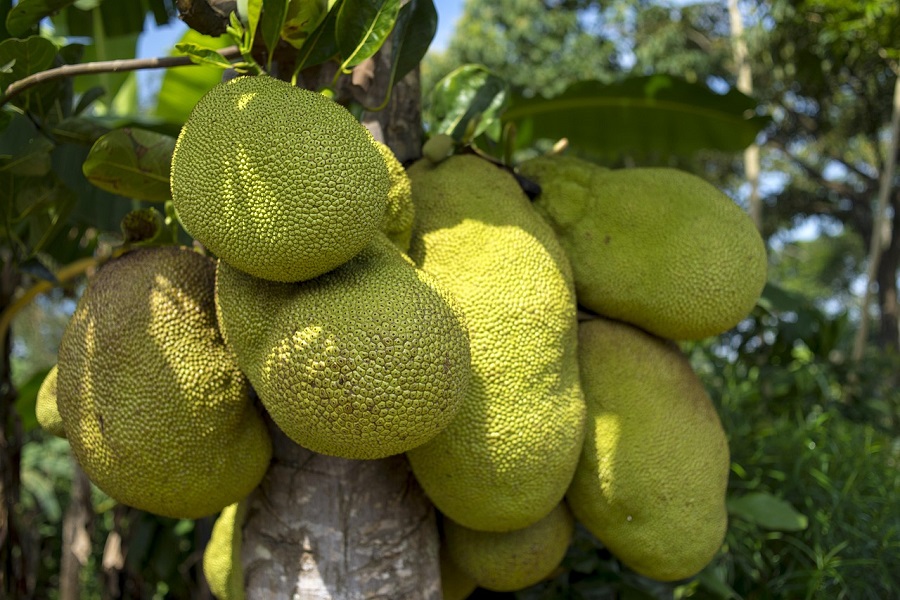
Jackfruit, known as kathal in Hindi, chakka in Malayalam, and palapalam in Telugu, is not just a fruit; it’s a cultural and nutritional powerhouse native to our country. Belonging to the Moraceae family, its origins are deeply rooted in the rainforests of the Western Ghats. Historically, it has been a vital food security crop in South and East India, often called the “poor man’s food,” but it is now rightly celebrated as a “superfood.”
Nutritional Value: Every part of the jackfruit is valuable. The fleshy bulbs (flakes) are rich in carbohydrates, dietary fiber, and vitamins like A, C, and B-complex. They contain minerals like potassium, magnesium, and iron. The seeds are a good source of protein and starch. Importantly, jackfruit is cholesterol-free and low in calories, making it a healthy choice.
Economic Importance: The economic potential of jackfruit is multi-layered. Primarily sold as a fresh fruit, its value has multiplied due to its use as a plant-based meat substitute. The young, unripe fruit (tender jackfruit) is used in curries and pickles, while the ripe fruit is eaten fresh or processed. Commercial & Processing Uses are rapidly expanding and include:
- Value-Added Products: Canned tender jackfruit, jackfruit chips, jackfruit flour, jams, and juices.
- Vegan Meat: Processed into shreds or chunks for use in burgers, biryanis, and tacos.
- Seed Utilization: Roasted seeds, seed flour, and starch extraction.
- Other Uses: The wood is termite-resistant and used for furniture, while the latex has industrial applications.
Climate & Soil Requirement
🌤️ Climate for Jackfruit Cultivation
Jackfruit is a hardy tropical tree but performs best under specific conditions.
- Suitable Climate: Thrives in warm, humid tropical and subtropical climates. It cannot tolerate extreme heat (like desert regions) or prolonged cold.
- Temperature Range: The ideal range is 25°C to 35°C. Growth stalls below 15°C. Young trees are highly sensitive to frost.
- Rainfall Requirement: Prefers annual rainfall between 1500 mm to 2500 mm, well-distributed throughout the year. It can withstand short dry spells once established.
- Sunlight Needs: Requires full sunlight (at least 6-8 hours daily) for optimal growth, flowering, and fruiting. Dense shade drastically reduces yield.
- Chill Hour Requirement: None. Being a tropical plant, it has no chilling requirement.
- Wind: Young plants need protection from strong, hot winds. Mature trees have a strong canopy but can suffer branch breakage in cyclonic winds.
India Context – Best States & Regions:
- Traditional Belts: Kerala, Karnataka (coastal and Malnad regions), Tamil Nadu, Maharashtra (Konkan), West Bengal, Assam, Bihar, Odisha, and the Northeastern states.
- Expanding Regions: With proper management, it can be successfully cultivated in the foothills of Uttarakhand and Himachal, parts of Andhra Pradesh, Telangana, Gujarat, and Madhya Pradesh.
🌱 Soil Requirement
Jackfruit is not very fussy about soil but gives the best yields in the right medium.
- Best Soil Type: Deep, well-drained, loamy soil is ideal. The tree has a strong taproot system that needs depth to anchor and access water and nutrients.
- Soil pH Range: Slightly acidic to neutral, between 6.0 and 7.5, is optimal. The tree can tolerate mild salinity but not extreme alkalinity.
- Drainage Requirement: Excellent drainage is critical. Stagnant water or waterlogged conditions, even for 2-3 days, can cause root rot and kill the tree, especially when young.
- Soil Preparation Tips: If your soil is heavy clay, you must improve drainage by adding river sand and organic matter. In sandy soil, water retention can be improved by incorporating plenty of farmyard manure (FYM) or compost.
Best Jackfruit Varieties for Cultivation
Choosing the right variety is the first step to success. Select based on your market (fresh fruit or processing) and local climate.
Indian Traditional Varieties:
- Singapore (or Syncone): Early bearing (starts in 2.5-3 years), dwarf tree, sweet bulbs, ideal for high-density planting. Popular in Kerala and Tamil Nadu.
- Muttam Varikka: From Kerala. Known for its firm, crispy, and sweet bulbs with less latex. Excellent for fresh consumption.
- Siddu: From Karnataka’s Malnad region. Fruits are medium-sized with very sweet, deep-yellow bulbs.
- Hazari (or Ghila): From Eastern India (West Bengal, Assam). Prolific bearer, produces many medium-sized fruits.
- Rudrakshi: Fruits are small to medium, with small seeds and sweet bulbs. Good for canning.
Improved / Hybrid Varieties:
- Swarna (CFSIR Selection): From ICAR-CISH, Lucknow. Seedless (parthenocarpic), early bearing, soft bulbs with excellent sweet taste.
- Sreejith (Konkan Ashwini): Developed by Konkan Krishi Vidyapeeth. Dwarf tree, early and heavy bearing, good for processing.
- Surabhi (PPI Jackfruit 1): A hybrid from Kerala, known for its consistent yield and good quality bulbs.
- Muttom Varikka (Improved Clones): Tissue-cultured or grafted clones of the best Muttom trees ensure uniformity and quality.
Government-Recommended Varieties:
Indian Council of Agricultural Research (ICAR) institutes recommend varieties based on region. For example, Swarna and Singapore are widely recommended for North Indian plains, while Muttam Varikka and Hazari are promoted in their native regions.
Region-wise Suitability (General Guide):
- South India: Singapore, Muttam Varikka, Surabhi, Siddu.
- Western India (Konkan): Sreejith (Konkan Ashwini), Singapore.
- Eastern & North-Eastern India: Hazari, Rudrakshi, Singapore.
- North Indian Plains: Swarna, Singapore, Hazari.
Propagation Methods in Jackfruit
Using quality planting material is crucial. Avoid growing trees from random seeds, as they will be unpredictable and take 7-8 years to fruit.
- Seed Propagation: Not recommended for commercial farming due to long juvenile period (7-8 years) and high variability in fruit quality. Useful for raising rootstock.
- Grafting: The most common and reliable method. Softwood grafting is highly successful (80-90% success rate). A scion (twig) from a desired variety is joined to a seedling rootstock. Grafted plants start bearing in 4-5 years and retain the mother tree’s qualities.
- Budding: Patch budding is also effective but less common than grafting.
- Rootstock Selection: Use vigorous, disease-free seedlings from known varieties as rootstock.
- Nursery Preparation: Buy plants only from certified nurseries or government horticulture departments. Look for healthy, pest-free grafted plants that are 9-12 months old.
- Plant Requirement per Acre/Hectare:
- For 8m x 8m spacing: ~70 plants/acre, ~175 plants/hectare.
- For 10m x 10m spacing: ~45 plants/acre, ~110 plants/hectare.
- For high-density (6m x 6m): ~110 plants/acre, ~275 plants/hectare.
Land Preparation for Jackfruit Orchard
Proper land preparation sets the foundation for a healthy orchard that will last decades.
- Field Preparation: Clear the land of all weeds, stones, and previous crop residues. Perform deep ploughing (up to 60-90 cm) to break any hardpan and allow root penetration.
- Ploughing: 2-3 cross ploughings are recommended to achieve fine tilth. Level the field properly to avoid water stagnation.
- Pit Size: Dig pits at least 3-4 weeks before planting. Size: 1m x 1m x 1m (length x width x depth). Keep topsoil and subsoil separate.
- Spacing & Layout: Mark the field according to your chosen spacing (8x8m or 10x10m). Use a square or hexagonal system for optimal light interception.
- FYM / Organic Manure Mixing: Fill the pit with a mixture of topsoil + 25-30 kg of well-rotted Farm Yard Manure (FYM) or compost + 1 kg of neem cake + 500 grams of Single Super Phosphate (SSP) + 100 grams of Trichoderma viride bio-fungicide. This mix nourishes the plant and protects against soil-borne diseases.
- Soil Treatment: If the area has a history of termites, mix Chlorpyriphos dust (as per label recommendation) into the pit filling mixture.
Planting Method of Jackfruit
- Best Planting Season: The onset of the monsoon (June-July) is ideal. This gives the sapling a full rainy season to establish its roots. In irrigated areas, planting can also be done in early spring (February-March).
- Planting Depth: Plant the sapling at the same depth it was in the nursery bag. Do not bury the graft union (the bulge where scion meets rootstock). It should remain above the soil.
- Spacing & Distance: As discussed: Standard – 8m x 8m to 10m x 10m. High-Density (for dwarf varieties like Singapore) – 6m x 6m.
- Planting Technique: Make a small hole in the center of the prepared pit. Remove the polythene bag carefully without breaking the soil ball. Place the plant, fill the gaps with soil, and press gently. Water immediately and thoroughly.
- Mulching: Apply a thick layer of dry leaves, paddy straw, or grass clippings around the base (leaving a gap near the stem). Mulching conserves soil moisture, suppresses weeds, and enriches soil as it decomposes.
- Staking: Provide a sturdy stake (bamboo pole) to support the young plant against strong winds.
Irrigation in Jackfruit Farming
While jackfruit is drought-tolerant once established, careful irrigation in the initial years ensures good growth.
- Water Requirement: Mature trees have deep roots and need less frequent watering. Young trees (1-3 years) need regular moisture.
- Irrigation Interval:
- First Year: Water every 3-4 days in summer, once a week in winter. No irrigation needed during heavy rains.
- 2nd-5th Year: Water once a week in summer, every 15 days in winter.
- Mature Trees (5+ years): Irrigation during dry summer months (March-May) at 15-20 day intervals is beneficial for fruit development.
- Critical Growth Stages: Water is crucial during new flush growth, flowering, and fruit development stages (January to May). Water stress during these phases can lead to flower/fruit drop.
- Drip Irrigation System: Highly recommended for jackfruit orchards. It saves 40-50% water, delivers water directly to the root zone, and is ideal for fertigation. Install 2-4 drippers per tree.
- Rainfed Farming: In high-rainfall areas (>2000 mm), established orchards may not need irrigation. Ensure proper mulching to retain soil moisture during dry spells.
- Effects of Water Stress: Causes flower drop, small fruit size, poor pulp quality, and cracking of ripe fruit. Conversely, waterlogging kills roots.
Manure & Fertilizer Schedule
Jackfruit responds well to organic manures. A balanced approach ensures healthy growth and high yields.
Year-wise Fertilizer Schedule (per plant per year)
| Year | FYM/Compost (kg) | N (g) | P2O5 (g) | K2O (g) | Application Time |
|---|---|---|---|---|---|
| 1st Year | 10-15 | 50 | 40 | 50 | Split into two doses (Jun & Sep) |
| 2nd Year | 15-20 | 100 | 80 | 100 | Split into two doses (Jun & Sep) |
| 3rd Year | 20-25 | 150 | 120 | 150 | Split into two doses (Jun & Sep) |
| 4th Year Onwards (Bearing Tree) | 25-40 | 500-600 | 300-400 | 600-800 | Apply FYM + full P & K + 1/3 N before flowering (Dec-Jan). Apply remaining 2/3 N after fruit set (Mar-Apr). |
Practical Tips:
- Micronutrients: Spray 0.5% Zinc Sulphate and 0.2% Boron once before flowering to improve fruit set and quality.
- Fertigation: If using drip, water-soluble fertilizers (19:19:19, 13:0:45, etc.) can be applied through the system in small, frequent doses.
- Organic Nutrient Options: Can replace chemical fertilizers entirely. Use combinations of Vermicompost, Neem Cake, Mustard Cake, Bone Meal (for P), and Wood Ash (for K). Jeevamrutha and Panchagavya are excellent liquid organic supplements.
- Always apply fertilizers in a circular trench around the tree (at the drip line, where roots are active) and mix well with soil, followed by irrigation.
Intercropping & Weed Management
🌾 Intercropping in Jackfruit Orchard
For the first 4-5 years, the space between jackfruit trees is large. Intercropping generates early income and improves soil health.
- Short-term Income-generating Crops: Vegetables like beans, cowpea, radish, carrot, cucumber, and leafy greens. Pineapple, ginger, and turmeric are excellent long-duration intercrops for shade-tolerant conditions.
- Soil-Improving Crops: Grow legumes like soybean, black gram (urad), or green gram (moong). They fix atmospheric nitrogen, benefiting the main crop. These can be ploughed back into the soil as green manure.
- Important: Keep a clear circle of at least 1.5-2 meters diameter around the jackfruit tree free from intercrops to avoid competition for water and nutrients.
🌿 Weed Management
- Manual Weeding: Necessary, especially during the first 2-3 years. Weed 3-4 times a year, particularly before fertilizer application.
- Mulching: The best long-term solution. A thick organic mulch (10-15 cm) suppresses 90% of weeds, conserves moisture, and adds organic matter.
- Organic Weed Control: Use natural weedicides like corn gluten meal or spray vinegar-based solutions on young weeds (take care not to spray on jackfruit leaves).
- Herbicides: Generally not recommended in young orchards due to risk of damage. In mature orchards, non-residual, contact herbicides like Glyphosate (with a shield) can be used on weeds, strictly avoiding any spray drift onto the tree.
Pruning and Training System
Proper shaping of the tree in the initial years is vital for a strong structure and easy harvesting later.
- Training Systems: The goal is to develop a tree with 3-5 well-spaced, strong main branches (primary scaffold) arising from the trunk at a height of about 1 meter from the ground.
- First-Year Pruning: When the sapling reaches about 1.5 meters, pinch the terminal bud to encourage side branching.
- Seasonal Pruning: Prune during the dormant season (after harvest or in late winter). Remove:
- Dead, diseased, and damaged branches.
- Water shoots (vertical, non-fruiting branches) from the interior.
- Crossing branches that rub against each other.
- Lower branches touching the ground.
- Benefits of Pruning: Improves light penetration and air circulation inside the canopy, reduces pest/disease incidence, directs energy towards fruit production, and maintains tree height for easier harvest.
- Impact on Yield & Fruit Quality: A well-pruned tree produces larger, better-quality fruits that are easier to bag and harvest. Overcrowded trees produce many small, poor-quality fruits.
Pests and Diseases in Jackfruit Farming
Jackfruit is relatively hardy but can be affected by some pests and diseases. Regular monitoring is key.
Major Pests:
- Shoot and Fruit Borer: Larva bores into young shoots and fruits. Symptoms: Wilting of shoots, exuding gum from fruit entry holes.
Control: Remove and destroy affected shoots/fruits. Spray Neem oil (3 ml/L) or Chlorantraniliprole 18.5% SC (0.3 ml/L). - Mealybugs & Aphids: Suck sap from leaves and shoots, secrete honeydew leading to sooty mould. Control: Spray Neem oil soap solution or Dimethoate 30% EC (1 ml/L).
- Stem Borer: Larvae bore into the main trunk. Symptoms: Sawdust-like excreta at the base. Control: Inject kerosene or Chlorpyriphos into holes and plug with clay.
- Jackfruit Leaf Webber: Caterpillars web and feed on leaves. Control: Remove webbed leaves. Spray Spinosad 45% SC (0.3 ml/L).
Major Diseases:
- Rhizopus Fruit Rot (Soft Rot): Serious in rainy season. Fungus causes rapid softening and rotting of young fruits. Control: Bag young fruits. Spray Carbendazim 50% WP (1 g/L) or Mancozeb (2 g/L) as a preventive spray.
- Dieback: Fungal infection causing drying back of twigs from tip downwards. Control: Prune and burn affected branches 6 inches below infection. Spray Copper Oxychloride (3 g/L).
- Leaf Spot: Small brown spots on leaves. Control: Usually not serious. Maintain orchard hygiene. Spray Mancozeb if severe.
General Preventive Measures: Maintain orchard sanitation (remove fallen leaves/fruits), ensure good drainage, avoid overcrowding, and encourage beneficial insects like ladybugs.
Flowering and Fruiting Stage
- Flowering Time: Main flowering season is December to March in most parts of India. Some varieties may have an off-season bloom (July-August).
- Pollination Requirements: Jackfruit is monoecious (has separate male and female flowers on the same tree). It is primarily insect-pollinated (flies, bees) and wind-pollinated. No need for manual pollination.
- Fruit Set: After pollination, the female flower head (initial fruit) starts swelling. Natural fruit drop occurs; only a fraction of flowers develop into mature fruits.
- Maturity Period: From fruit set to harvest takes 120 to 180 days, depending on the variety and climate. Fruits grow rapidly in the final month.
- Practical Tip: For better-sized and borer-free fruits, practice fruit bagging. When the fruit is about the size of a cricket ball, cover it with a polypropylene or paper bag. This improves color and protects from pests and birds.
Harvesting of Jackfruit Fruit
Harvesting at the right stage is crucial for quality and shelf life.
- Harvesting Time: For tender jackfruit (vegetable use), harvest when the fruit is 3-4 months old, and spines on the rind are still soft and green. For ripe fruit, harvest in the morning or late afternoon to avoid heat.
- Maturity Indicators for Ripe Fruit:
- A dull, hollow sound when tapped.
- Spines on the rind become flattened and wide apart.
- Fruit emits a strong, sweet aromatic smell.
- The last leaf of the fruit stalk turns yellow.
- Harvesting Method: Use a sharp sickle or clipper with a long pole. Cut the stalk, leaving 2-3 cm attached to the fruit. Never let the fruit drop to the ground, as it will bruise and spoil quickly. Handle fruits carefully to avoid latex oozing.
- Post-Harvest Handling:
- Wipe off the latex with a cloth dipped in mustard or sesame oil.
- Keep harvested fruits in a shaded, cool place.
- For transport, pack fruits in cushioned crates or baskets.
Yield of Jackfruit Crop
Yield varies greatly with variety, age, and management practices.
- Yield per Plant: A healthy, well-managed tree can produce:
- 4th-5th year: 10-25 fruits.
- 8th-10th year (full bearing): 50-150 fruits.
- Peak age (15-50 years): 100-250 fruits.
- Yield per Acre: Assuming 70 trees at full bearing (avg 100 fruits/tree, avg fruit weight 8 kg):
70 trees x 100 fruits x 8 kg = 56,000 kg or 56 tonnes. This is a theoretical maximum. A practical, achievable yield is between 8 to 20 tonnes per acre per year. - Yield per Hectare: Approximately 2.5 times the acre yield: 20 to 50 tonnes per hectare per year.
- Factors Affecting Yield: Poor soil, water stress, lack of nutrients, inadequate sunlight, heavy pest/disease infestation, lack of pollination, and improper pruning.
Storage and Marketing of Jackfruit
Effective post-harvest handling determines your final profit.
- Storage Methods:
- Ripe Fruit: Can be stored at room temperature for 3-5 days. At 11-13°C and 85-90% relative humidity, it can be stored for 2-3 weeks.
- Cut Fruit: Bulbs separated from the rind can be stored in airtight containers in a refrigerator for up to a week, or frozen for months.
- Tender Jackfruit: Can be cut into chunks, blanched, and frozen for long-term storage.
- Cold Storage: Essential for commercial scale. Cooperatives or FPOs can invest in cold storage to extend marketability.
- Transport: Use ventilated trucks. Pack fruits carefully with cushioning to prevent bruising during transit.
- Local Markets: Wholesale to mandis, direct sales to retailers, or roadside stalls.
- Processing & Value-Added Products: This is where maximum profit lies. Consider small-scale processing into:
- Vacuum-packed tender jackfruit for curry.
- Jackfruit chips (ripe or unripe).
- Jackfruit flour (from dried seeds/bulbs).
- Ready-to-eat jackfruit chunks in brine for vegan products.
- Export Potential: Huge demand from the USA, Europe, Middle East, and Southeast Asia for frozen tender jackfruit, canned products, and chips. Contact APEDA (Agricultural and Processed Food Products Export Development Authority) for export protocols and subsidies.
Cost of Jackfruit Farming & Profit Margin
Here is a simplified cost and profitability analysis for one acre of jackfruit cultivation (70 plants, 8m x 8m spacing) over 10 years.
| Cost Component | Initial Years (Year 1-3) *Total for 3 years | Bearing Years (Year 6-10) *Per Year |
|---|---|---|
| Land Preparation, Pits, Planting Material | ₹ 35,000 – ₹ 50,000 | – |
| FYM, Fertilizers, Micronutrients | ₹ 15,000 – ₹ 20,000 | ₹ 8,000 – ₹ 12,000 |
| Irrigation (Drip System + Water) | ₹ 40,000 – ₹ 60,000 (Drip Capital Cost) | ₹ 3,000 – ₹ 5,000 |
| Labor (Weeding, Pruning, Application) | ₹ 20,000 – ₹ 30,000 | ₹ 10,000 – ₹ 15,000 |
| Plant Protection | ₹ 5,000 – ₹ 8,000 | ₹ 3,000 – ₹ 5,000 |
| Intercrop Income (Net) | (₹ 20,000 – ₹ 40,000) *Credit* | – |
| Total Establishment Cost (Years 1-3) | ₹ 95,000 – ₹ 1,28,000 (After subtracting intercrop income) |
– |
| Annual Maintenance Cost (Year 6-10) | – | ₹ 24,000 – ₹ 37,000 |
Income & Profit Projection (From 6th Year Onwards)
- Market Price (Farm Gate): Highly variable. Tender jackfruit: ₹15-₹30/kg. Ripe fruit: ₹10-₹25/kg. Premium processed products fetch much higher prices (₹100-₹300/kg).
- Expected Annual Yield (6th-10th year): 8-12 tonnes/acre (conservative estimate).
- Expected Annual Income (@ avg ₹15/kg): 10,000 kg x ₹15 = ₹ 1,50,000.
- Annual Maintenance Cost: ₹ 30,000 (average).
- Net Profit per Acre per Year: ₹ 1,50,000 – ₹ 30,000 = ₹ 1,20,000.
- ROI Timeline: Initial investment is recovered by the 7th or 8th year. From the 8th year onwards, the orchard becomes highly profitable for the next 50+ years with minimal incremental cost.
Advantages of Jackfruit Cultivation
- High & Growing Market Demand: Domestic and international demand is rising rapidly for fresh and processed jackfruit.
- Good Export Value: Fetches premium prices in foreign markets as a vegan superfood.
- Exceptionally Long Lifespan: A one-time investment yields returns for over 60 years, benefiting multiple generations.
- Suitable for Diverse Regions: Can be grown in hills, plains, and coastal areas, making it a national crop.
- Government Support: Eligible for subsidies under various horticulture missions.
- High Processing Potential: Reduces post-harvest losses and increases farmer income manifold.
- Climate Resilient: Tolerates drought and requires fewer chemical inputs compared to many other fruit crops.
Government Schemes for Jackfruit Farming
Several central and state schemes offer financial assistance:
- Mission for Integrated Development of Horticulture (MIDH): Provides subsidies for planting material, drip irrigation, machinery, and post-harvest infrastructure. Subsidy can range from 40-60% of cost.
- National Horticulture Mission (NHM): Similar support under state plans. Contact your District Horticulture Officer.
- Subsidy Schemes: For drip/sprinkler systems (up to 55% subsidy), polyhouses, and cold storage units.
- Nursery Support: Many state horticulture farms sell certified quality saplings at subsidized rates.
- Training Programs: Krishi Vigyan Kendras (KVKs) and State Agricultural Universities (SAUs) conduct training on jackfruit cultivation and processing.
- State-Wise Benefits: States like Kerala, Karnataka, and Maharashtra have specific jackfruit promotion policies. Check your state’s horticulture department website.
Organic Jackfruit Cultivation
Jackfruit is ideally suited for organic farming due to its inherent hardiness.
- Organic Inputs: Rely entirely on farm-generated resources.
- Compost & Vermicompost: Primary source of nutrients.
- Biofertilizers: Apply Azospirillum and Phosphobacteria at planting and annually.
- Natural Pest & Disease Control: Use Neem-based products (cake, oil, kernel extract), Dashparni ark, garlic-chilli extract. Encourage predators like birds and ladybugs.
- Green Manure: Grow and plough in legumes like sunnhemp.
- Certification Basics: For selling as “Organic,” get certified under NPOP (National Programme for Organic Production) through agencies like APEDA. The process involves a 3-year conversion period, detailed record-keeping, and annual inspections.
- Benefit: Organic jackfruit commands a 20-50% higher price in specialized markets and exports.
Common Mistakes in Jackfruit Farming
Avoid these pitfalls to ensure success:
- Wrong Planting Material: Using seed-grown, unknown variety saplings. Solution: Always buy grafted plants from certified sources.
- Poor Spacing: Planting too close leads to overcrowding, poor light, and reduced yields in 5-6 years. Solution: Follow recommended spacing based on variety.
- Ignoring Drainage: Planting in waterlogged areas kills trees. Solution: Ensure excellent drainage; plant on mounds in heavy soil.
- Over-Irrigation: Watering too frequently, especially in clay soil, causes root rot. Solution: Water only when topsoil feels dry.
- Improper Pruning: Neglecting to shape the tree when young results in an unmanageable giant. Solution: Start formative pruning from the first year.
- Weak Pest Management: Ignoring borers and fruit rot until it’s too late. Solution: Regular monitoring and preventive bagging/spraying.
- Harvesting Too Late: Letting the fruit overripen on the tree affects quality and shelf life. Solution: Learn maturity indices and harvest on time.
FAQs – Frequently Asked Questions
1. Is jackfruit farming profitable in India?
Yes, it is highly profitable in the long term. After an initial investment period of 5-7 years, a well-maintained orchard can yield a net profit of ₹1-2 lakh per acre per year for over 50 years.
2. How long does a jackfruit tree take to bear fruit?
A grafted tree starts bearing fruits in the 4th or 5th year. Seed-grown trees take much longer, about 7-8 years.
3. Which soil is best for jackfruit cultivation?
Deep, well-drained loamy soil with a pH between 6.0 and 7.5 is ideal. Good drainage is more important than soil type.
4. Can jackfruit grow in plains?
Absolutely. It grows well in the plains of North, East, South, and Central India, provided there is no frost and the soil is well-drained.
5. How much water does jackfruit need?
Young trees need regular watering (once a week). Mature, deep-rooted trees are drought-tolerant but benefit from irrigation during dry summers and critical growth stages.
6. What is the lifespan of a jackfruit tree?
A jackfruit tree is very long-lived. Its economic fruit-bearing lifespan is 60-70 years, but the tree itself can live for over 100 years.
7. What are the best intercrops for jackfruit?
In initial years, grow legumes (moong, urad), vegetables, pineapple, ginger, or turmeric. Avoid tall crops like sugarcane or maize.
8. How can I control fruit borer in jackfruit?
The most effective method is bagging young fruits with polybags. As a spray, use Neem oil or recommended insecticides at the early fruit stage.
9. Is there a seedless jackfruit variety?
Yes. Swarna variety, developed by CISH, Lucknow, is parthenocarpic (seedless) and has excellent fruit quality.
10. What is the best season to plant jackfruit?
The beginning of the monsoon (June-July) is the best time for planting across India.
11. How much fertilizer does a mature jackfruit tree need?
A mature bearing tree needs about 25-40 kg FYM, 500-600g N, 300-400g P2O5, and 600-800g K2O per year, applied in split doses.
12. Can I grow jackfruit in a water-scarce area?
Yes, once established (after 4-5 years), jackfruit is quite drought-tolerant due to its deep taproot. Using drip irrigation and mulching makes it feasible in water-scarce regions.
Conclusion
Jackfruit farming is more than just agriculture; it’s an investment in a sustainable and prosperous future. As we’ve seen, this native Indian crop offers remarkable resilience, low maintenance costs once established, and a booming market driven by health-conscious consumers and the plant-based food revolution. The journey requires patience for the first 5-7 years, but the rewards-a steady, high income for decades, are well worth the wait.
Start by choosing the right grafted variety for your region, prepare your land with care, and follow the practical steps for irrigation, nutrition, and pest management outlined in this guide. Explore intercropping for early returns and seriously consider value addition and organic certification to maximize your profits. Remember to connect with your local horticulture department to avail of available subsidies and training.
The jackfruit tree has silently sustained generations. Now, it’s time to cultivate it purposefully and let it become a pillar of your agricultural income. Take the first step today. Visit a nearby government nursery, talk to a successful jackfruit grower in your area, and prepare your land for this golden harvest of the future. Your future self, and the next generation, will thank you for it.