Drip Irrigation for Fruit Orchards: A Complete Practical Guide for Indian Farmers
In 2023, India extracted 241 billion cubic metres of groundwater – 210 billion of it for irrigation alone. Farmers across Karnataka, Maharashtra, Rajasthan, Andhra Pradesh, and Uttar Pradesh are drilling deeper every season, chasing a water table that keeps falling. Borewells that once hit water at 20 metres now go past 100. Over 60% of wells in a 100-village Karnataka study had already dried up completely.
Flood irrigation – still used on 84% of India’s irrigated farmland – wastes between 40% and 60% of every litre pumped. For fruit farmers growing mango, guava, banana, papaya, or pomegranate, that is not just an environmental problem. It is a direct hit to income, season after season.
Drip irrigation does not solve the groundwater crisis on its own. But for a fruit farmer working a one-to-five acre orchard, it is the single most practical step available – cutting water use by 35% to 65%, improving yields by 33% to 41%, and paying for itself within a few seasons through labour and fertilizer savings alone.
What is Drip Irrigation and How Does It Work?
The government classifies it under Sookshma Neeravari – micro-irrigation. In Maharashtra, farmers call it “thomb thomb paani.” The name captures the logic: water reaches each tree drop by drop, only at the root, only in the quantity the plant needs.
Rather than flooding the field and letting water spread across bare ground between trees, a drip system pushes water through buried pipes to the base of each plant. The soil around the root stays moist. The open ground between tree rows stays dry. That one change eliminates the bulk of what flood irrigation wastes.
The system runs through five parts working together.
At the water source – borewell, open well, or canal – a pump and filter unit controls the head. The filter is the most critical piece in Indian conditions. Borewell water across peninsular India, the Deccan, and the hard-rock aquifer zones of Rajasthan carries fine silt and dissolved minerals. Without filtration, those particles reach the small emitter openings at each tree and block them within weeks.
A fertigation tank – typically 200 litres – sits inline between the filter and the mainline. Water-soluble fertilizers dissolve inside and travel with the irrigation water directly to the root zone. Broadcasting fertilizer on the soil surface loses 40–50% to evaporation and runoff. Through a fertigation tank, the same nutrient dose reaches the roots in one cycle.
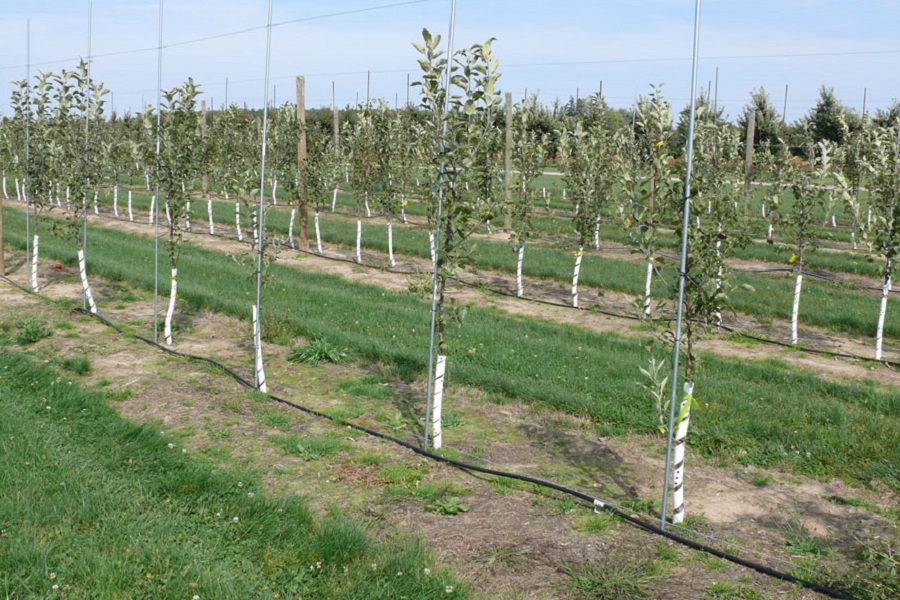
Mainline and sub-main PVC pipes carry water from the pump across the field. Burying them two to three feet underground keeps them out of harm during inter-cultivation ploughing and prevents the heat-expansion cracking that destroys surface-laid PVC within one South Indian summer.
Lateral pipes – 16mm LLDPE – run along each tree row. At every tree, one or two emitters release water at 4 to 8 litres per hour. Lighter sandy soils found across Rajasthan and coastal Andhra Pradesh need 4 LPH to allow slow percolation. Heavier clay soils of the Deccan and Cauvery basin handle 6 to 8 LPH without pooling at the root crown.
The result: a wet zone of 45 to 60 cm around each tree’s root system. Nothing more, nothing wasted.
Which Fruit Crops Benefit Most
Mango and guava are planted at wide spacings – 20×20 or 30×30 feet across most Indian orchards. With flood irrigation, water covers the large stretches of bare earth between trees, evaporates under summer heat, and feeds weeds. Drip puts the water on the tree. Nothing else. In large mango orchards across Andhra Pradesh and Uttar Pradesh, this alone cuts irrigation labour by more than half.
Banana and papaya need steady moisture but cannot survive waterlogging. Their root systems are shallow and suffocate quickly in saturated soil – a recurring problem in Maharashtra’s black cotton soil and across the clay-loam Cauvery belt. Drip holds soil at field capacity: moist enough for active growth, aerated enough for roots to breathe.
Pomegranate, grown heavily in Maharashtra, Karnataka, and parts of Gujarat, is drought-tolerant but cracks badly when soil moisture fluctuates during flowering and fruit development. Any sudden shift at that stage causes internal pressure that splits the fruit skin. Split pomegranates do not sell. Drip eliminates the fluctuation.
Citrus and sapota – major crops in Maharashtra and Gujarat – show strong yield gains under drip because fruit enlargement is directly sensitive to water consistency. A single drought episode followed by heavy irrigation causes fruit drop and skin splitting in both crops.
Research from IIHR Hesarghatta in Bangalore and Tamil Nadu Agricultural University shows 35%–65% water savings and 33%–41% yield improvements across banana, mango, and guava compared to flood irrigation. Fruit quality improves too – size uniformity and Brix (sugar content) are measurably higher when the plant never experiences moisture stress during fruit development.
What It Costs to Set Up on One Acre
All figures below are for ISI/BIS-certified materials in 2025–26. Non-certified pipes are ineligible for subsidy and crack within one growing season under Indian summer heat.
| Component | Cost per Acre (₹) |
| Mainline and Sub-main PVC (buried) | ₹12,000 – ₹18,000 |
| Laterals and Emitters (16mm LLDPE) | ₹18,000 – ₹25,000 |
| Filtration System | ₹10,000 – ₹12,000 |
| Fertigation Unit | ₹5,000 – ₹8,000 |
| Installation Labour | ₹4,000 – ₹6,000 |
| Total | ₹49,000 – ₹69,000 |
System lifespan: 7 to 10 years with certified materials. Annual upkeep – filter cleaning, worn emitter replacement, small leak fixes – runs ₹2,000 to ₹4,000 per acre. Fertigation cuts fertilizer spend by 20–30% every season, which partially offsets the annual running cost.
Government Subsidies Under PMKSY – Across India
The Pradhan Mantri Krishi Sinchayee Yojana (PMKSY) – Per Drop More Crop component – funds drip installation across all Indian states through Centre-State cost sharing.
National baseline: 55% subsidy for small and marginal farmers, 45% for others, up to 5 hectares for fruit and plantation crops. States add on top of this.
Karnataka’s Horticulture Department brings total coverage to up to 90% for small and marginal farmers on the first 2 hectares. Maharashtra’s scheme supports small farmers at 80–85%. Tamil Nadu through TANHODA and PMKSY combined reaches 75–90% by crop. Andhra Pradesh and Telangana have extended 100% support to SC/ST farmers under specific programmes. As of August 2024, Karnataka alone has 1.68 million hectares under micro-irrigation – 22% of the country’s total.
How to apply:
- Register on your state farmer portal using Aadhaar, land records (RTC/Pahani in Karnataka, Jamabandi in north Indian states), and bank details to get your Farmer ID
- Apply through the Agriculture or Horticulture Department online, or visit the nearest Raitha Samparka Kendra (Karnataka) or Krishi Vigyan Kendra (other states)
- Documents needed: Aadhaar, land record, Farmer ID, bank passbook, vendor quotation
- Field inspection by a department officer
- Installation by an approved vendor with ISI/BIS materials only
- Subsidy paid via Direct Benefit Transfer (DBT) to your bank account after verification
Subsidy percentages change with state budgets each year – confirm current rates at your district Horticulture Department before filing.
Six Steps to Install Drip on a One-Acre Orchard
Map your water source first. Measure borewell yield in litres per hour. A 100-tree mango orchard at 4 LPH per tree needs 400 LPH minimum. If the borewell yields less, plan a storage sump that fills overnight.
Get a layout designed before buying materials. Mark tree spacing and row distances on paper. Reputable drip vendors provide free layout designs – this determines pipe diameters and total quantities. Never buy materials before the layout is done.
Match filtration to your water quality. In high-sand borewell zones across peninsular India and the Deccan, a Hydrocyclone filter ahead of the disc filter removes heavy particles before fine filtration. Prevention here saves far more than any emitter replacement later.
Bury the mainlines. At least 2 feet underground – away from ploughs, heat, and machinery.
Pressure-test before finishing. After laying laterals and connecting emitters, run the pump and walk the full field. Far-end emitters discharging noticeably less than near-end ones signals a pressure drop – upsize the mainline or switch to pressure-compensating emitters for that zone.
Flush before fitting end caps. Run the pump with all lateral end caps open and let water flow freely for several minutes. This clears manufacturing dust and installation debris. Fitting end caps before flushing is the most common field error – trapped debris blocks the farthest emitters within the first few weeks.
Four Mistakes That Kill Drip Systems Early
Not cleaning the filter. Silt and minerals from Indian borewells accumulate fast. The filter needs cleaning every one to two weeks during active irrigation. Pressure drops gradually when it blocks – by the time you notice wilting at the far end of the field, significant crop stress has already happened.
Wrong emitter discharge for the soil. An 8 LPH dripper on heavy clay water logs the root crown. Start with 4 LPH on unknown soil, observe moisture spread after two hours, then decide.
Non-ISI pipes. Cheaper upfront. Cracked within one season. No subsidy eligibility. The 15–20% price difference is not worth it across a 7–10 year system life.
No pressure gauge. Two gauges – one at the pump, one at the mainline end – cost ₹300–500 total. Without them, an underground leak or blocked filter only becomes visible as crop damage.
Conclusion
India’s groundwater is not recovering fast enough to absorb the way it is currently being used for irrigation. For fruit farmers, the most practical response available today is shifting from flood to drip – reducing consumption by 35%–65% while improving yield and fruit quality at the same time.
With the PMKSY subsidy covering up to 90% of installation costs in several states, and a system that pays for itself through labour and fertilizer savings within a few growing seasons, the barrier to adoption is lower than most farmers realise.
Start with one acre. Get the filtration right. Use certified materials. The rest follows.
Frequently Asked Questions
Is drip irrigation good for mango trees? Yes – it is the preferred method across India’s major mango-growing states. Steady moisture through drip prevents the stress that causes alternate bearing, which is the most common reason mango orchards skip a productive year.
Can the subsidy cover 100% of installation cost? In specific categories – SC/ST farmers in Karnataka, Andhra Pradesh, and Tamil Nadu – state top-up support combined with PMKSY can bring personal contribution very close to zero for the first 2 hectares. Confirm current rates at your district Horticulture Department before applying.
Can I use liquid fertilizers through the system? Yes. Water-soluble NPK, calcium nitrate, and potassium nitrate are standard through Indian fruit farm drip systems. Use only grades marked “Fit for Fertigation” – granular fertilizers do not dissolve cleanly and block emitters over time.
How do I clean the lateral pipes each season? Remove end caps and flush for 10–15 minutes at season end. In hard-water regions, a diluted citric acid solution flushed through the mainline dissolves calcium scale inside LLDPE pipes without damaging them. Once a year is sufficient.
Drip or sprinkler – which is better for fruit orchards? Drip, for established trees. Sprinklers wet the canopy and the open ground between rows equally – encouraging fungal infections and feeding weeds. Drip keeps the canopy dry, targets only the root zone, and leaves inter-row soil dry enough to suppress weed growth.
The author Netravati O is a digital marketing professional specialising in agricultural land and managed farmland developer sectors in Karnataka. She writes on farm operations, irrigation practices, and land investment for urban buyers. She is associated with Misty Valley Farms, a managed farmland community near Bangalore. Website: themistyvalley.in”